Texas Driver's Permit Diagnostic Quiz
Find your weak spots before you book the test. 10 questions drawn from the topics the Texas driver manual spends the most time on. You'll see which topics need work the moment you finish; enter your email at the end and we'll send the full ranked plan with exact scores and the chapters to study next.
Texas Driver's Permit Diagnostic Quiz (10 questions). Correct answers and explanations follow each question.
-
1. According to the Texas manual's color table, what does the color red mean on a road sign?
- Motorist services guidance
- Construction and maintenance warning
- Stop, yield, or do what is posted (correct)
- General warning or caution
Why: The manual's color table gives red the meaning stop, yield, or do what is posted on the sign, so a red-backed sign is prohibiting or commanding an action. The trap is general warning or caution: that description belongs to yellow, and drivers who lump red and yellow together as 'the alert colors' pull yellow's row onto red's line.
-
2. According to the Texas manual, which kinds of posted speed limits must drivers obey?
- Only signs posted inside cities and towns.
- Both minimum and maximum posted limits. (correct)
- Only the limit posted on numbered highways.
- Only signs that show a maximum in mph.
Why: The manual's Speed Limits section opens by requiring drivers to obey posted minimum AND maximum limits. Choice D tempts drivers who think of a speed limit only as a ceiling; those drivers have never noticed the separate minimum-speed signs Texas posts on some higher-speed highways to keep traffic moving.
-
3. Yellow diagonal stripes inside a solid yellow border fill a rectangle between opposing-direction lanes. What does this require of you?
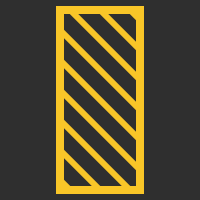
- Use it as a two-way left-turn lane for turns to either side.
- Do not drive into the striped area. (correct)
- Treat it as a passing zone for opposing traffic.
- Stop inside the stripes before merging into the next lane.
Why: A rectangle outlined in solid yellow and filled with diagonal stripes is a painted median between opposing-direction lanes, and it is closed to travel. The trap is the two-way left-turn lane, which also sits between opposing traffic and uses yellow paint; a driver who learned that rule first carries it over. But a two-way left-turn lane is bounded by a solid outer yellow and a broken inner yellow with no diagonal fill, and it exists to be entered for turns. The diagonal stripes flag pavement not meant for any travel at all.
-
4. You reach an intersection with no signals, no signs, and no lane or pavement differences. Before you cross, what does the manual tell you to make sure of?
- That your headlights are on to make yourself visible.
- That another driver has waved you into the intersection.
- That the driver on your right has come to a full stop first.
- That there are no approaching vehicles from the left. (correct)
Why: At an uncontrolled intersection the manual tells you to check that no vehicles are approaching from the left before proceeding, because you may legally have right-of-way but still need the other driver to yield. Wrong answer C tempts a driver who reads "yield to the right" as "wait for the right to stop"; the manual grants the right-side driver priority, never a duty to stop first.
-
5. A white 'NO PARKING' legend is painted on the pavement along the curb ahead. What does it require of you?
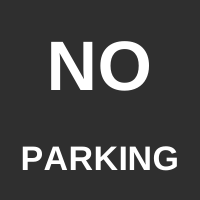
- Park briefly if you leave your hazard lights on.
- Do not park a vehicle in that space. (correct)
- Park there outside posted business hours.
- The prohibition applies only during posted rush hours.
Why: The painted NO PARKING legend means you cannot park a vehicle in that space; treat it the same way you would a posted No Parking sign. The idea that flashing hazard lights buy you a quick stop is borrowed from delivery vans double-parking, and the painted word does not read blinkers.
-
6. You are driving on a two-lane road that meets a divided road with three lanes going the same direction. No signs or signals control the intersection. Who has the right-of-way?
- Vehicles on the three-lane road have the right-of-way. (correct)
- Vehicles on the two-lane road, since it is the narrower one.
- Vehicles on the two-lane road, since they arrived first.
- Whichever vehicle is turning has the right-of-way here.
Why: At an uncontrolled intersection where a single or two-lane road meets a divided or three-or-more-lane road, the driver on the two-lane road yields to traffic on the wider road. Drivers who fall back on the four-way-stop habit of "whoever got here first goes" pick option C, but arrival order does not settle a lane-count crossing.
-
7. You are in a left-turn lane and see a flashing yellow arrow for your direction. According to the Texas manual, what does this signal allow?
- You may only turn left if no oncoming traffic will reach the intersection.
- Oncoming vehicles must yield to you while you complete the turn.
- You must stop and wait for a green arrow before turning.
- You may turn left but must yield to oncoming traffic. (correct)
Why: A flashing yellow arrow permits a left turn only after yielding the right-of-way to oncoming traffic. Option C is the trap for drivers who confuse this signal with a steady red arrow and wait for a green arrow that is not required here.
-
8. You approach an intersection controlled by a flashing yellow light. According to the Texas manual, what should you do?
- Yield only to vehicles already in the intersection.
- Maintain speed and drive straight through.
- Slow down and proceed with caution. (correct)
- Stop completely, then proceed when clear.
Why: A flashing yellow warns drivers to slow down and proceed with caution. Option D is the trap for drivers who treat every flashing signal alike; the stop-then-go rule belongs to flashing red, not flashing yellow.
-
9. A Texas highway is posted at 70 mph on a clear afternoon. The manual's basic speed law tells you what?
- You may not drive faster than is safe for existing conditions. (correct)
- The posted number is your minimum during clear weather.
- You may drive faster than 70 if traffic is moving faster.
- The posted number applies day and night without exception.
Why: The basic speed law caps you at whatever speed is safe for actual conditions, no matter what number the sign shows. Choice B tempts drivers who confuse the posted maximum with a required minimum, because Texas does post separate minimum-speed signs on some higher-speed routes and drivers who saw one can blur the two authorities together.
-
10. According to the Texas manual, what sign shape is used exclusively for stop signs?
- Diamond
- Octagon (correct)
- Equilateral triangle
- Pentagon
Why: The manual's shape table assigns the octagon exclusively to stop signs, which is why a driver can identify the rule from a distance before reading the word STOP. The trap is equilateral triangle: it sits one row above in the same 'exclusively' list and is the other shape a learner memorizes as an exact-match pair with stop, so the two get swapped in recall.
Where to go next.
Ready for a longer go? Take the full Texas practice test or jump into the topic study guide.
This diagnostic is one snapshot. The Texas book unlocks a companion that turns it into a ranked study plan and re-ranks your weakest topics every time you practice, so the top of the list is always what to drill next. Own the Texas book to unlock it.