Texas Practice Test
A full-length practice test for the Texas DPS knowledge test.
25 Questions Click an answer to reveal the explanation








Texas Practice Test (25 questions). Correct answers and explanations are noted under each question.
-
1. You're driving 55 mph and the road is wet from steady rain. What does the manual say to do with the 4-second following interval it lists for good road conditions?
- Slow down and increase the following distance beyond four seconds. (correct)
- Switch to one car length for every 10 mph of speed.
- Keep the 4-second gap; it's the manual's minimum for speeds above 30 mph.
- Drop back to a 2-second gap so a hydroplaning car can clear it faster.
Why: For speeds above 30 mph, the manual's 4-second gap is only the good-conditions baseline; once the pavement is wet it says plainly to slow down and increase the following distance, meaning more time than four seconds. Option C comes from reading that 4-second figure as an all-weather minimum that already accounts for rain, so no adjustment gets added once the road is wet.
Source: Texas Driver Manual, "Chapter 8: Speed and Speed Limits (Speed)," p.45.
-
2. What does this Lodging sign tell a driver?
- A hotel, motel, or other overnight lodging is available ahead. (correct)
- A public rest area with restrooms is available ahead.
- A restaurant or food service is available ahead.
- A campground for overnight camping is available ahead.
Why: The blue Lodging services sign marks a hotel, motel, or other overnight lodging near the exit ahead. The choice pointing to a rest area is the trap because both signs are blue services panels, and a driver who does not check the pictograph reaches for the roadside stop a highway traveler uses more often. The person-lying-in-a-bed pictograph separates them: it signals a paid room for the night, not a roadside pull-out.
Source: Manual on Uniform Traffic Control Devices, sign D9-9 (Lodging).
-
3. Your vehicle is on the opposite side of the street from a fire station entrance. How far from the entrance must you stay per the Texas manual?
- 75 feet (correct)
- 20 feet
- 30 feet
- 50 feet
Why: The Texas manual sets seventy-five feet as the parking distance opposite a fire station entrance. Twenty feet is the trap: that is the distance the same sentence gives for the fire station's own side of the driveway, and a driver taking the first number in the clause carries it over to the opposite side without checking that the sentence continues.
Source: Texas Driver Manual, "Do Not Park or Stand a Vehicle," p.42.
-
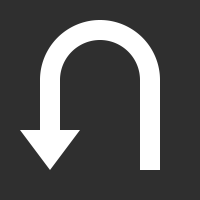
4. What does this pavement marking permit a driver in the lane to do?
- Reverse direction with a U-turn at the intersection. (correct)
- Make a left turn only at the intersection.
- Use the lane for left turns from either direction of travel.
- Execute a three-point turn to change direction.
Why: A curved arrow that loops a full 180 degrees marks the lane as one where U-turns are permitted, so a driver may reverse direction at the intersection. The trap sits with the plain left-turn reading: a left-turn arrow bends once toward the left and stops there, while the U-turn arrow wraps the whole way around to show the reversal, and the two markings sit close enough in shape that the loop gets misread as an ordinary left.
Source: Manual on Uniform Traffic Control Devices, marking 3B.24 (U-Turn Arrow).
-
5. You are starting a pass on a Texas two-lane road. According to the manual, which signal should you turn on first?
- High beams flashed twice.
- Right turn signal.
- Hazard flashers.
- Left turn signal. (correct)
Why: Step one of the passing sequence on a two-lane road is turning on your left turn signal so drivers behind you know your plan. The reasoning error in B is jumping ahead to the return step of the pass, where the right signal is used to move back over once the other car is cleared.
Source: Texas Driver Manual, "Chapter 6: Signaling, Passing, and Turning (How to Pass on a Two-Lane Road)," p.39.
-
6. White stop lines are painted across the pavement at a Texas signal. When the line is present, where does the manual say you must stop?
- On top of the stop line
- Behind the stop line, without crossing it (correct)
- Past the stop line but before the crosswalk
- At the edge of the intersection
Why: The manual says that where white stop lines are painted, you're required to stop behind the stop line. Drivers who ease onto the line are running the parking-lot habit of aligning the bumper with a painted stripe, but a stop line is a limit to stay behind, not a mark to touch.
Source: Texas Driver Manual, "Pavement Markings - White Stop Lines," p.34.
-
7. What does this Food sign tell a driver about the road ahead?
- A restaurant or other place to eat is available ahead. (correct)
- A rest area with picnic tables lies ahead.
- Overnight lodging is offered near this exit.
- Fuel can be purchased at the next exit.
Why: The blue Food sign, a white fork and knife inside a circle, points to a restaurant or other place to eat off the highway ahead. The rest-area answer is the reach: a driver who groups every blue roadside services sign into a single 'rest stop' bucket picks it, without noticing the fork-and-knife icon that reserves this sign for dining.
Source: Manual on Uniform Traffic Control Devices, sign D9-8 (Food).
-
8. The word BIKE is painted in white inside a travel lane. What does this pavement legend identify?
- A lane designated for the preferential use of bicyclists (correct)
- A lane where motorists and bicyclists share the space
- A crossing where bicyclists ride across the roadway
- A curbside space reserved for bicycle parking
Why: The BIKE word legend marks a bicycle lane, the portion of the roadway set aside for the preferential use of riders. Drivers who pick the shared-lane answer are confusing this word legend with the sharrow, the bicycle symbol topped by two white chevron arrows used when motorists and bicyclists share the same lane.
Source: Manual on Uniform Traffic Control Devices, marking 3C.02 (BIKE Pavement Legend).
-
9. The word YIELD is painted in white across the lane ahead of you. What does this marking require?
- Slow down, prepare to stop, and yield to cross traffic or pedestrians. (correct)
- Come to a complete stop before the word and proceed when clear.
- Merge into the adjacent lane before reaching the marking.
- Maintain speed and continue straight through the intersection.
Why: The white YIELD legend supplements a Yield sign and tells you to slow, be ready to stop, and hand right-of-way to whatever cross traffic, pedestrians, or merging vehicles are ahead. The trap is the answer that treats the marking as a stop legend. A driver used to the octagonal STOP marking assumes any word painted across the lane commands a full halt, but YIELD only forces a stop when yielding actually requires one.
Source: Manual on Uniform Traffic Control Devices, marking 3B.21 (YIELD Pavement Word Marking).
-
10. You are passing another vehicle on the right on a Texas road. According to the manual, what limit does this rule have?
- You may not exceed the posted speed limit.
- You may not drive off the paved portion of the highway. (correct)
- You may pass only in a designated shoulder lane.
- You may pass only on divided highways.
Why: Texas allows a right-side pass in narrow conditions, but the manual bars you from driving off the paved portion of the highway to do it. Drivers who reach for a speed-limit qualifier are borrowing the "keep to the speed limit while passing" habit from general passing advice; the manual singles out the pavement itself, not your speed, as the limit.
Source: Texas Driver Manual, "Chapter 6: Signaling, Passing, and Turning (Passing on the Right)," p.39.
-
11. A series of wide white bars is painted across the road, parallel to the direction of traffic, like piano keys. What does this marking indicate?
- A high-visibility pedestrian crosswalk. (correct)
- A stop line telling drivers where to halt at the intersection.
- A yield line telling drivers to slow and give way.
- A rumble strip designed to alert drowsy drivers.
Why: A series of wide white bars painted across the road, parallel to the direction of traffic, marks a continental crosswalk, a high-visibility pedestrian crossing. Drivers must yield to pedestrians within it, must not stop on or block the bars, and must not pass another vehicle stopped for someone in the crossing. The stop-line answer comes from confusing these parallel bars with the single perpendicular white line at an intersection that tells drivers where to halt; the two markings run in different directions and carry different meanings.
Source: Manual on Uniform Traffic Control Devices, marking 3B.18 (Continental Crosswalk).
-
12. According to the Texas manual, what three things must you do when leaving your vehicle?
- Turn the motor off, roll up the windows, and lock the doors
- Turn the motor off, set the parking brake, and remove the key (correct)
- Set the parking brake, shift into neutral, and remove the key
- Turn the motor off, remove the key, and leave the hazard lights on
Why: The manual's Chapter 7 opens by naming the three things a driver does on leaving the vehicle: turn the motor off, set the parking brake, and remove the key. Rolling up windows and locking the doors is a habit worth having, and a driver who picks A is defaulting to the routine their parents taught rather than to what this section actually lists.
Source: Texas Driver Manual, "Chapter 7: Parking, Stopping, or Standing," p.41.
-
13. Under what specific condition does Texas double traffic fines in a construction or maintenance work zone?
- Only when speeding is the violation
- At any time, day or night
- When workers are present anywhere in the zone (correct)
- Only during posted work-zone hours
Why: Texas ties doubled fines to workers being present anywhere in the zone, not to the zone existing on its own. Drivers pick 'any time' because they remember the orange 'Fines Double' sign posted at the zone's entry and read it as always active, missing that the manual conditions the increase on active workers.
Source: Texas Driver Manual, "Obey Warning Signs and Barricades," p.37.
-
14. What should you do when this Hill sign warns of a downgrade ahead?
- Reduce speed and shift to a lower gear before starting down. (correct)
- Stop completely at the crest before beginning the descent.
- Yield to any vehicles climbing the grade from below.
- Hold your speed and rely on the brakes throughout the descent.
Why: The Hill sign warns that a steep downgrade is ahead, and the safe response is to slow down and shift to a lower gear before you start down so engine braking helps control your speed. The answer that says to hold your speed and rely on the brakes is the trap: it borrows the everyday habit of tapping the brakes on a mild slope, which lets the brakes overheat and fade on a real grade.
Source: Manual on Uniform Traffic Control Devices, sign W7-1 (Hill).
-
15. Which practice does the manual list as a way to reduce distraction while driving?
- Limit any single conversation to under one minute.
- Speak only when the car is fully stopped.
- Keep the radio at a low volume during any conversation.
- Don't engage in complex or emotionally intense conversations. (correct)
Why: The manual names avoiding complex or emotionally intense conversations with other occupants as the specific way to reduce distraction. A pulls in a call-length rule drivers use for their own phone habits and applies it to face-to-face conversation, which the manual measures by topic and intensity rather than by the clock.
Source: Texas Driver Manual, "Distracted driving," p.53.
-
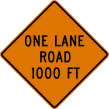
16. What does this orange diamond warning sign tell you about the road ahead?
- One lane about 1,000 feet ahead shared by traffic in both directions. (correct)
- Two lanes merge into one in your direction of travel ahead.
- The road is closed to through traffic 1,000 feet ahead.
- A one-way street begins 1,000 feet ahead.
Why: The sign warns that about 1,000 feet ahead the road narrows to one lane that both directions of traffic must share, so you slow down and prepare to yield to oncoming vehicles or a flagger. The trap is the choice that reads it as a lane-drop merge; a merge sign shows two same-direction lanes joining into one, while this sign specifically warns of two-way traffic sharing a single lane.
Source: Manual on Uniform Traffic Control Devices, sign CW20-4 (One Lane Road 1000 Ft).
-
17. Your Texas car came from the factory with a third, high-mounted brake light. According to the manual, what is the rule for that third lamp?
- It is optional as long as the two lower brake lights work
- It must be operational along with the two lower brake lights (correct)
- The two lower lights are optional as long as the third works
- Only one working brake light is required if the car has three
Why: Once a car left the factory with a third high-mounted brake light, all three lamps must work. Drivers who pick 'only one required' are reaching for the pre-1960 exception, which applies only to vehicles built before 1960 and only to the lower brake lights.
Source: Texas Driver Manual, "Required Equipment for Vehicles - Lights (Brake / Stop Lights)," p.15.
-
18. Which of the following is one of the four ways the Texas manual says traffic signs help you be a better driver?
- They mark the boundary between counties
- They regulate the speed and movement of traffic (correct)
- They flash to signal emergencies ahead
- They set fines for common traffic violations
Why: The manual lists 'regulate the speed and movement of traffic' as one of the four ways signs help a driver, alongside warning of hazards, guiding to destinations, and informing of local regulations. The trap is 'they set fines': signs do enforce the rule the fine attaches to, and a driver who reads 'regulate' as 'penalize' assumes the sign itself carries the penalty amount when the vehicle code sets that separately.
Source: Texas Driver Manual, "Chapter 5, Traffic Signs," p.25.
-
19. Your crash happened on a main lane, caused only vehicle damage, and both cars can still be driven safely. What does the manual require you to do?
- Leave both vehicles exactly as they came to rest until officers arrive.
- Wait in the travel lane with your hazards on until police direct you.
- Continue to the nearest gas station and phone the police from there.
- Move it to a crash investigation site, frontage road, cross street, or other suitable location. (correct)
Why: On a main lane, ramp, shoulder, median, or adjacent area, if both vehicles can be driven safely, the manual tells you to move them to a designated crash investigation site, the frontage road, the nearest suitable cross street, or another suitable location. Choice A reflects the older "never move a crash scene" habit that parents and driver's ed taught for years before Texas rewrote the statute so drivable damage-only crashes clear the traveled lanes.
Source: Texas Driver Manual, "Crash Resulting in Damage to a Vehicle," p.59.
-
20. An adult driver refuses to give a breath or blood specimen on a first arrest for driving while intoxicated. What is the license suspension?
- 90 days
- 365 days
- 180 days (correct)
- Two years
Why: Refusal on a first offense costs an adult 180 days. The 90-day answer in A belongs to a driver who took the test and blew 0.08 or higher; the two numbers sit a paragraph apart on the same page and get swapped.
Source: Texas Driver Manual, "Implied Consent Laws for Adults," p.58.
-
21. You have passed the last channelizing device in a Texas work zone. When does the manual say you may return to the normal driving lane?
- Immediately after passing the first cone
- When a flag person waves you back
- As soon as the lane opens up
- Only after checking traffic behind you (correct)
Why: The manual holds the lane change until you have checked traffic behind you, so a following driver already committed to that lane is not sideswiped. Drivers pick 'as soon as the lane opens up' because they focus on the space in front and skip the mirror check, the same habit that produces sideswipe crashes on any lane change.
Source: Texas Driver Manual, "Channelizing Devices," p.36.
-
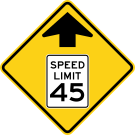
22. What does this Reduced Speed Limit Ahead sign require of a driver?
- Begin slowing so your speed is at or below the new limit by the regulatory sign that follows. (correct)
- Immediately drop to the value shown the moment you pass this sign.
- Slow only if current road conditions make the posted limit unsafe.
- Hold current speed until you reach the new regulatory speed-limit sign.
Why: This sign is advance notice. Begin slowing now so your speed is at or below the new limit by the time you reach the regulatory sign that actually posts it. The trap is the choice that says drop to the shown value the moment you pass the diamond. That reads the yellow warning as if it were the black-on-white regulatory posting, but a yellow diamond never sets the enforceable limit; the regulatory sign that follows does.
Source: Manual on Uniform Traffic Control Devices, sign W3-5 (Reduced Speed Limit Ahead).
-
23. Solid green pavement bordered by white lines identifies what?
- A bicycle lane highlighted where it crosses motor vehicle paths. (correct)
- A shared lane for bicycles and buses only.
- A pedestrian crossing painted for extra visibility.
- A lane permanently closed to all motor vehicle traffic.
Why: A continuous green field bordered by white lines marks a bicycle lane and calls attention to it where bicyclists and motor vehicles cross paths, such as intersections, driveways, and merges. The color raises the lane's visibility without changing its legal status. Drivers who read the vivid green as a permanent barrier pick D, mistaking a visibility treatment for a change in who may use the lane.
Source: Manual on Uniform Traffic Control Devices, marking FHWA IA-14 (Green-Colored Bike Lane).
-
24. According to the Texas manual, what sign shape is used exclusively for stop signs?
- Diamond
- Octagon (correct)
- Equilateral triangle
- Pentagon
Why: The manual's shape table assigns the octagon exclusively to stop signs, which is why a driver can identify the rule from a distance before reading the word STOP. The trap is equilateral triangle: it sits one row above in the same 'exclusively' list and is the other shape a learner memorizes as an exact-match pair with stop, so the two get swapped in recall.
Source: Texas Driver Manual, "Chapter 5, Table 17: Signs by Shape," p.26.
-
25. According to the Texas manual, a car's foot brake must be able to stop the vehicle within what distance at a speed of 20 mph?
- 25 feet (correct)
- 20 feet
- 40 feet
- 60 feet
Why: The manual sets the foot brake standard at stopping within 25 feet at 20 mph. Drivers who reach for 60 feet are recalling the 60-foot backing distance graded on the driving exam a few pages earlier and mistaking it for the brake rule.
Source: Texas Driver Manual, "Required Equipment for Vehicles - Brakes," p.15.
Keep going.
Want explanations one question at a time? Browse every Texas practice question or jump into the topic study guide. Ready to close the gaps for good? Own the Texas book and its study system.