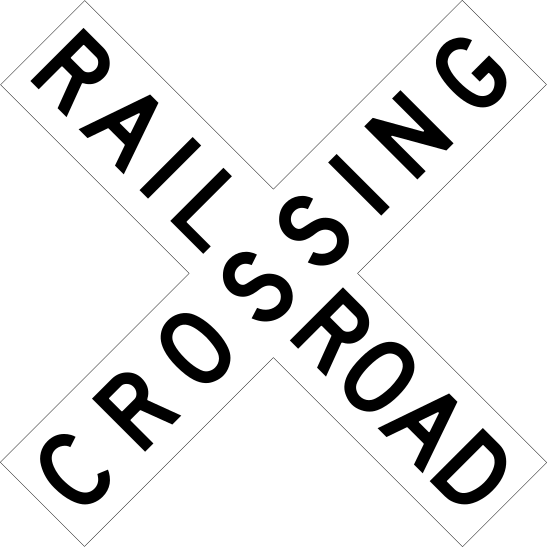
What does this crossbuck sign require of a driver approaching the tracks?
-
A.
Yield to any approaching train and cross only when the tracks are clear. Correct
-
B.
Come to a complete stop before every crossing, whether or not a train is approaching.
-
C.
Proceed without slowing because the crossbuck only marks the location of the tracks.
-
D.
Yield to cross traffic on the road that intersects at this location.
The answer is "Yield to any approaching train and cross only when the tracks are clear."
The crossbuck acts as a yield device at a highway-rail grade crossing: slow down, look and listen both ways, and cross only when no train is coming. The trap is the answer that treats every crossing as a mandatory stop, which carries a stop-sign habit over to a device that only demands a stop when a train is actually there.
The traps in the wrong answers
B. Come to a complete stop before every crossing, whether or not a train is approaching.
The crossbuck is a yield device, so a stop is required when necessary to yield to an approaching or occupying train, not on every approach to the tracks. This answer treats every railroad crossing as a mandatory halt and imports the stop-sign habit onto a yield device.
C. Proceed without slowing because the crossbuck only marks the location of the tracks.
The crossbuck is a regulatory marker that imposes a duty to yield, not a plain locator that lets a driver keep speed. This answer reads the sign as informational and skips the duty to slow and look for trains.
D. Yield to cross traffic on the road that intersects at this location.
The yield the crossbuck imposes runs to the train on the tracks, not to any road traffic at this point. This answer applies the yield to cross-street vehicles instead of to the approaching train.
This question tests your knowledge of Regulatory Signs on the roads of every US state . Source: Manual on Uniform Traffic Control Devices, sign R15-1 (Railroad Crossing (Crossbuck))..
Related questions
- What does this Do Not Enter sign require of a driver facing it? →
- When does the passing restriction created by this Do Not Pass sign end? →
- You are following a light rail vehicle on a shared street and see this R15-5a sign as the train stops at a station. What does it require of you? →
- You approach this sign posted at the front of a raised median that splits the roadway. What does it require of you? →
- What does this sign require of a driver turning left when the signal shows a solid green ball? →