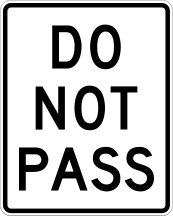
When does the passing restriction created by this Do Not Pass sign end?
-
A.
When a Pass With Care sign or permissive pavement markings appear ahead. Correct
-
B.
After you have driven 500 feet past the sign.
-
C.
When you reach the next intersection or cross street.
-
D.
When oncoming traffic clears and the road ahead looks empty.
The answer is "When a Pass With Care sign or permissive pavement markings appear ahead."
The restriction runs from the sign forward and is lifted only by a Pass With Care sign or by permissive pavement markings. The tempting wrong choice is the one that lets a clear stretch of road end the restriction; a driver used to judging passing by sight distance reads Do Not Pass as advice to weigh against conditions, when it is a rule that stays in force until a later sign or marking cancels it.
The traps in the wrong answers
B. After you have driven 500 feet past the sign.
This answer invents a fixed distance that the entry does not provide; the restriction stays in force until another sign or marking cancels it.
C. When you reach the next intersection or cross street.
Intersections do not lift a Do Not Pass restriction; only a Pass With Care sign or permissive markings do. This answer carries over the way lane-use restrictions such as turn-only lanes end at the next intersection and applies that habit to a passing rule.
D. When oncoming traffic clears and the road ahead looks empty.
The sign overrides the driver's own read of the road; the restriction holds even when a gap in oncoming traffic looks inviting. This answer confuses the sign with a yellow warning plate that leaves the call to the driver, when this white regulatory sign binds regardless of the road ahead.
This question tests your knowledge of Regulatory Signs on the roads of every US state . Source: Manual on Uniform Traffic Control Devices, sign R4-1 (Do Not Pass)..
Related questions
- What does this Do Not Enter sign require of a driver facing it? →
- You are following a light rail vehicle on a shared street and see this R15-5a sign as the train stops at a station. What does it require of you? →
- You approach this sign posted at the front of a raised median that splits the roadway. What does it require of you? →
- What does this sign require of a driver turning left when the signal shows a solid green ball? →
- What does this No Left Turn sign require of a driver in the lane where it is posted? →