Oregon Driver's Permit Diagnostic Quiz
Find your weak spots before you book the test. 10 questions drawn from the topics the Oregon driver manual spends the most time on. You'll see which topics need work the moment you finish; enter your email at the end and we'll send the full ranked plan with exact scores and the chapters to study next.
Oregon Driver's Permit Diagnostic Quiz (10 questions). Correct answers and explanations follow each question.
-
1. What does this lane-reduction arrow require you to do?
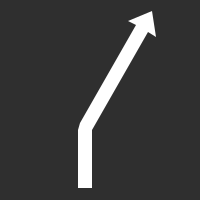
- Move into the next lane in the direction the arrow points before this lane ends. (correct)
- Turn in the direction the arrow points at the next intersection.
- Stay in this lane; adjacent traffic must yield so you can merge later.
- Continue straight; drivers in the adjacent lane must move over into your lane.
Why: A lane-reduction arrow warns that your lane is ending, and its bend points at the open lane you must merge into before the pavement runs out. The tempting wrong pick is the turn-arrow reading, since painted arrows on intersection approach lanes usually direct a required turn. But a mandatory-turn arrow runs straight the whole length of its shaft and sits in a dedicated turn pocket, while this arrow bends part-way along a through lane to say the lane itself is going away.
-
2. When driving past parked cars on an Oregon street, what does the handbook recommend?
- Cross into the next lane to give yourself the most room.
- Speed up past the parked cars to spend less time alongside them.
- Stay close to the parked cars to give the lane to your left.
- Move away from the parked cars within your lane. (correct)
Why: Keep extra space between your vehicle and parked cars by moving away from them without leaving your lane. A door may open in your path, or someone may step out from between parked vehicles. The cushion buys you time to react. Adjust your position within the lane instead of crossing the line. A is the trap for drivers who drop the 'without leaving your lane' qualifier and treat the cushion as a full lane change.
-
3. A diamond-shaped sign with a yellow background and a black symbol means:
- A guide to the next available exit.
- A rule that you must follow on the road.
- A construction zone or work area ahead.
- A hazard or change in the road ahead. (correct)
Why: Yellow with black symbols on a diamond is the standard warning category, alerting you to a known possible hazard or a change in road conditions ahead: a curve, a merge, slippery pavement when wet. Construction warnings share the diamond shape but switch to orange, so the color shift is the cue that the warning is temporary. Regulatory signs state the law (black on white rectangles, or the red prohibitive set), and guide information is green. Choice C trips drivers who forget that the shift from yellow to orange is what marks a work zone, and assign the yellow background to construction instead.
-
4. When are you required to stop at an Oregon railroad crossing?
- Only when following a school bus or hazmat vehicle that must stop at the tracks.
- When red lights flash, a train approaches, a stop sign is posted, or a flagger signals stop. (correct)
- Only when an approaching train is clearly visible on the tracks ahead.
- Only when the crossing gate has lowered completely across the road.
Why: You must stop at an Oregon railroad crossing whenever any of four triggers fires: flashing red lights, an approaching train visible or close enough that crossing would be hazardous, a posted stop sign, or a flagger signaling stop. Machine signals, human signals, posted signs, and your own judgment about train proximity each stand alone as reasons to stop. A driver drawn to A is pulling forward the manual's separate note that school buses and hazmat vehicles must stop at the tracks and reading it as the only trigger that obligates any driver.
-
5. You have a steady green light at an Oregon intersection, but the traffic ahead has stopped and there isn't room for your vehicle on the far side. What should you do?
- Enter and stop just past the crosswalk so you hold your place in line.
- Enter the intersection: your green light gives you the right of way.
- Enter slowly so you can clear the intersection as soon as the traffic ahead moves up.
- Wait behind the stop line until you can clear the intersection completely. (correct)
Why: Oregon's rule is explicit: even with a green light, you may not enter an intersection unless there is room for your vehicle on the other side. Waiting behind the stop line lets you cross in one continuous movement instead of stopping mid-intersection and blocking cross-traffic when the light changes. Drivers who read a green as unconditional permission pick B, applying the everyday rule they use at intersections that are not backed up rather than the narrower rule the manual states for this specific case.
-
6. A funeral procession is moving down an Oregon road with funeral flags on the vehicles. May you join the procession to take advantage of moving through traffic with them?
- Joining or driving between vehicles in the procession is illegal. (correct)
- Joining is allowed with hazard lights on.
- Joining is allowed if a police escort leads it.
- Joining at the back of the procession is allowed.
Why: Oregon law forbids non-members from joining or driving between vehicles in a funeral procession. Funeral processions are exempt from certain rules of the road (they may enter intersections without stopping and don't have to obey traffic control devices), but those exemptions apply only to procession members. Other vehicles must yield right of way to funeral processions. The back of the line looks harmless, and that's what makes D tempting; the manual bars non-members from joining anywhere in the procession, position irrelevant.
-
7. An extra-wide solid white line runs along the right side of the roadway. What does it tell you as a driver?

- Keep the line on your left and stay off the shoulder. (correct)
- Cross the line to pass slower traffic on the right.
- Stop your vehicle before crossing the line ahead.
- The lane is reserved for bicycles only.
Why: An extra-wide solid white edge line marks where the travel lane ends on the right, and the driver keeps it on the left while treating the shoulder beyond it as off-limits for normal driving. The tempting wrong choice reads the line as a broken lane divider that a driver may cross to move right, a rule that belongs to dashed white lines between two through lanes, not to an edge line whose whole job is to mark the outer boundary of the lane you are already in.
-
8. How can you measure your following distance in seconds while driving in Oregon?
- Count the seconds it takes the vehicle ahead to pass between two fixed objects.
- After your vehicle passes a sign or pole, count the seconds until the driver behind you reaches it.
- Count the seconds from when the driver ahead brakes until you begin braking.
- Count the seconds from when the rear of the vehicle ahead passes a fixed object until you reach that spot. (correct)
Why: Watch for when the rear of the vehicle ahead passes a fixed object, such as a sign or pole. Then count the seconds it takes you to reach the same spot. If you pass the mark before finishing at least two seconds, you are following too closely. Increase the space and count again at another spot until you are no closer than two seconds behind. Answer A carries over a stopwatch method that times the lead vehicle between two roadside points, when the count runs on your own travel to the single spot its rear just passed.
-
9. An Oregon traffic light is flashing red. How should you treat it?
- As a yield sign: slow down and proceed when the way is clear.
- Stop only if you can do so safely; otherwise drive carefully through.
- Drive through without stopping if no traffic is visible.
- As a stop sign: come to a complete stop, then go when safe. (correct)
Why: Oregon treats a flashing red like a stop sign: come to a complete stop before the stop line or crosswalk, yield to any pedestrians and cross traffic, and proceed only when it is safe. Choice B is the tempting miss because it borrows the steady-yellow rule (if you cannot stop safely, drive carefully through) and misapplies it to a flashing red, which the manual makes as strict as a stop sign.
-
10. A white sign with a red circle and a slash through a symbol means:
- The action shown is recommended.
- The action shown is a warning.
- The action applies only at posted times.
- The action shown is prohibited. (correct)
Why: A red circle with a slash through a symbol is the universal prohibition mark: it tells you the action shown inside the circle is not allowed (no left turn, no right turn, no U-turn, and so on). Recommendations and advisories do not use a slashed circle, warnings use yellow diamonds, and time-of-day limits are spelled out in text on regulatory signs. Choice A flips the sign's meaning entirely, reading the slashed circle as an endorsement of the pictured action when the mark exists precisely to forbid it.
Where to go next.
Ready for a longer go? Take the full Oregon practice test or jump into the topic study guide.
This diagnostic is one snapshot. The Oregon book unlocks a companion that turns it into a ranked study plan and re-ranks your weakest topics every time you practice, so the top of the list is always what to drill next. Own the Oregon book to unlock it.