Oregon Practice Test
A full-length practice test for the Oregon DMV knowledge test.
35 Questions Click an answer to reveal the explanation






Oregon Practice Test (35 questions). Correct answers and explanations are noted under each question.
-
1. Which of these is NOT one of Oregon's mandatory minimum auto-insurance coverages?
- Uninsured Motorist coverage.
- Bodily Injury and Property Damage liability.
- Personal Injury Protection (PIP).
- Comprehensive coverage. (correct)
Why: Oregon law names three mandatory coverages: Bodily Injury and Property Damage liability, Personal Injury Protection, and Uninsured Motorist Coverage. Comprehensive pays for theft, fire, and vandalism to your own vehicle, and the state does not require it. Drivers coming from states where UM is sold as an optional upgrade often mislabel it as an add-on and reach for A.
Source: Oregon Driver Manual, "Mandatory Insurance," p.93.
-
2. Your headlights stop working at night while driving in Oregon. What does the manual recommend?
- Shift to a lower gear and slowly apply the parking brake.
- Stop in your current lane and wait for help.
- Turn on your hazard lights and continue driving at your normal speed.
- Toggle the switch, try other lights, slow down, and ease onto the shoulder. (correct)
Why: Toggling the headlight switch off and on can reset a bad contact. If that does not work, high beams, driving lights, or hazard lights may give you enough light to find a safe place to leave the road. Slow down and ease onto the shoulder. The other lights are there to guide you off the road, not to let you keep driving, and the lower-gear and parking-brake steps belong to the brake-failure procedure, not this one. A driver who hears 'try other lights' as permission to keep going picks C and drops the 'slow down' half of the rule.
Source: Oregon Driver Manual, "Headlights Go Out," p.85.
-
3. The white word legend SCHOOL XING is painted in your travel lane. What does it warn you to do as you approach?
- Slow down, scan both sides for children, and be ready to stop for a pedestrian or crossing guard. (correct)
- Stop at the legend and wait for a crossing guard to wave you through.
- Reduce speed only after a child steps into the roadway ahead.
- Change into a non-adjacent lane before reaching the school property.
Why: The SCHOOL XING legend warns that a school crossing is just ahead. Slow down, scan both sides of the road for children, and be ready to stop for a pedestrian or crossing guard using the crosswalk. Drivers who wait until a child steps into the roadway are treating the marking as a reactive brake cue, when a legend printed ahead of the crossing exists to prepare you before anyone appears.
Source: Manual on Uniform Traffic Control Devices, marking 3B.21 (SCHOOL XING Pavement Legend).
-
4. Are you allowed to put stickers or other objects on the windows of your Oregon vehicle?
- Yes, as long as the stickers are small.
- Yes, anywhere on the windows is fine.
- Yes, only if they don't block your view. (correct)
- Yes, but only on the rear window.
Why: You must be able to see what is to the front, sides, and rear of your vehicle. Do not load or equip your vehicle in any way that blocks what you can see. Stickers or other objects placed on the windows are allowed only when they do not block your view of the road. Even a small obstruction in a critical sight line can hide a pedestrian or motorcycle. The temptation in A is to swap a size test for the manual's actual rule, which forbids anything that blocks the view no matter how small.
Source: Oregon Driver Manual, "Defensive Driving," p.73.
-
5. You see this yellow diamond sign on approach. What should you be prepared to do at the intersection ahead?
- Slow down and yield to vehicles already in the circle (correct)
- Come to a full stop before entering the circle
- Enter first because circle traffic must yield to you
- Continue at speed since the sign only marks the exit
Why: The yellow diamond warns of a roundabout ahead, so slow on approach and be ready to obey the entry yield control that gives priority to vehicles already circulating counterclockwise. Drivers carrying the four-way-stop habit into every intersection pick the full-stop answer, reading any yellow warning as a signed halt when the diamond only announces what is coming.
Source: Manual on Uniform Traffic Control Devices, sign W2-6 (Circular Intersection (Roundabout)).
-
6. What does this Merge Right sign warn of ahead?
- Traffic from the right merges into your lane ahead. (correct)
- A lane on the right ends and drivers must move left.
- The roadway narrows from both sides ahead.
- Two-way traffic begins on the roadway ahead.
Why: The diamond warns that traffic from the right merges into your lane ahead, which is why you check your right mirror and blind spot as you approach and adjust speed for vehicles joining. The trap is the answer about a lane ending and drivers moving left; that is the Lane Ends sign, and readers pick it because both signs feature a slanting line and get filed together on first pass.
Source: Manual on Uniform Traffic Control Devices, sign W4-1R (Merge Right).
-
7. You've had a drink and used marijuana before driving in Oregon. According to the driver manual, what does combining the two substances do to your ability to drive?
- Driving is unaffected as long as your BAC stays under 0.08%.
- The combination can reduce your ability to drive safely. (correct)
- Marijuana counteracts the alcohol, making driving safer than after drinking alone.
- Marijuana has little effect at the wheel because it metabolizes slowly, so the alcohol is the main concern.
Why: The Impaired Driving section addresses the combination directly: the use of alcohol and marijuana together can reduce a person's ability to drive safely. Separately, the manual notes marijuana impairment has contributed to many collisions in Oregon, and that alcohol is the most common drug involved when drivers are impaired. Both substances impair driving on their own, and neither offsets nor cancels the other. The folk belief behind C, that one drug balances out another, gets no endorsement from the manual.
Source: Oregon Driver Manual, "Impaired Driving," p.82.
-
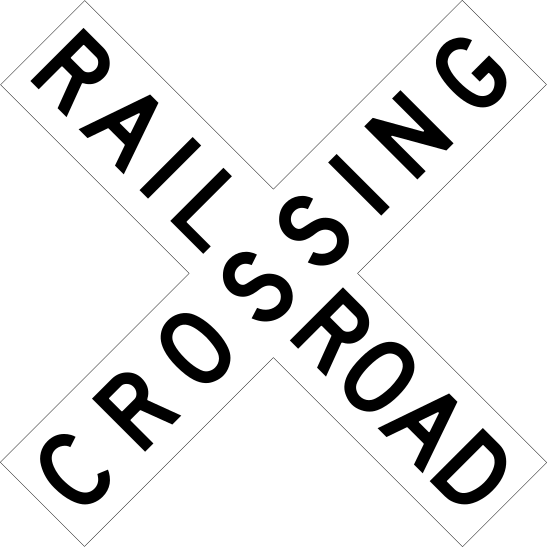
8. What does this crossbuck sign require of a driver approaching the tracks?
- Yield to any approaching train and cross only when the tracks are clear. (correct)
- Come to a complete stop before every crossing, whether or not a train is approaching.
- Proceed without slowing because the crossbuck only marks the location of the tracks.
- Yield to cross traffic on the road that intersects at this location.
Why: The crossbuck acts as a yield device at a highway-rail grade crossing: slow down, look and listen both ways, and cross only when no train is coming. The trap is the answer that treats every crossing as a mandatory stop, which carries a stop-sign habit over to a device that only demands a stop when a train is actually there.
Source: Manual on Uniform Traffic Control Devices, sign R15-1 (Railroad Crossing (Crossbuck)).
-
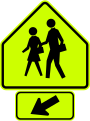
9. This school crossing assembly has a downward diagonal arrow plaque mounted beneath the pentagon. What does the arrow indicate?
- The exact crosswalk where children cross the road. (correct)
- The direction to the nearest school building.
- A school zone somewhere ahead on the road.
- The side of the road where children walk to school.
Why: The arrow on this assembly points to the exact crosswalk where children cross the road, which is why the assembly is posted at the crossing itself rather than in advance of it. The wrong answer to watch for is the one that treats the sign as a warning of a zone somewhere ahead; that describes the plain pentagon school sign posted before you reach the area, not this arrow-plaque version posted at the crosswalk.
Source: Manual on Uniform Traffic Control Devices, sign S1-1+W16-7P (School Crossing Assembly).
-
10. You enter a marked Safety Corridor. What should you do?
- Slow down for the work zone marked by diamond-shaped flags.
- Turn on your lights for safety. (correct)
- Turn on your hazard lights.
- Reduce your speed by 10 mph.
Why: Safety Corridors are designated stretches of highway with more fatal and serious injury collisions than the statewide average. The instruction when driving through one is simple: turn on your lights for safety. The signs identifying a corridor may include diamond shaped flags, but those flags are part of the corridor signing itself, not a work-zone marker. Drivers who borrow the school-zone or work-zone habit of dropping a set number of mph pick answer D, even though a Safety Corridor sets no posted reduction.
Source: Oregon Driver Manual, "Route, Guide, and Information Signs: Safety Corridors," p.13.
-
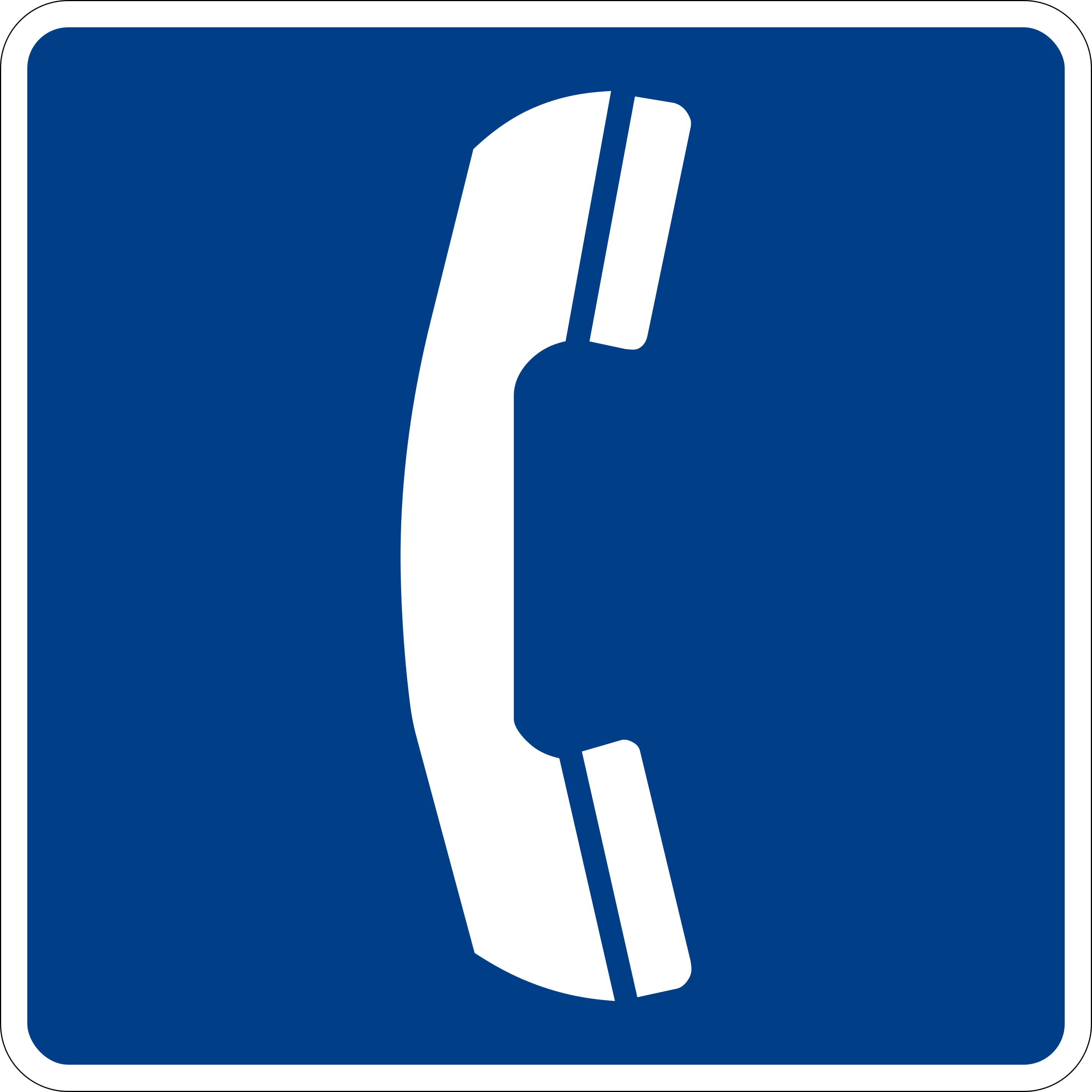
11. What does this Telephone sign tell a driver about the road ahead?
- A public telephone is available ahead. (correct)
- A rest area with restrooms is ahead.
- Cellular phone use is not allowed here.
- An emergency call box requires you to stop.
Why: The white handset on a blue square is a motorist service symbol, and blue services signs point drivers to something helpful ahead: here, a public telephone. The sign marks the phone itself, not any larger facility around it. The rest-area answer is the trap. Because the phone symbol often appears at rest stops, a reader can expect the sign to advertise the whole facility rather than the single service actually pictured on it.
Source: Manual on Uniform Traffic Control Devices, sign D9-1 (Telephone).
-
12. While driving in Oregon, should you hold a small dog in your lap?
- No, unless the pet is secured in a harness on your lap.
- No. Do not hold a pet in your lap or arms. (correct)
- Yes, only if the dog is calm.
- Yes. Oregon has no rule against holding a pet while you drive.
Why: The Oregon Driver Manual lists holding a person, pet, or package in your lap or arms among the distractions to avoid, with no exception for how the animal is secured or how calm it seems. Choice A tempts drivers who read the ban as a restraint rule with a harness carveout, the way child-seat law works for passengers; Choice C leans on the rule of thumb that a calm pet is a safe pet.
Source: Oregon Driver Manual, "Distracted Driving," p.80.
-
13. A five-sided yellow sign means:
- A school zone or school crossing is ahead. (correct)
- A narrower section of road is ahead.
- Two-way traffic is ahead.
- A railroad crossing is ahead.
Why: The five-sided pentagon yellow sign marks the beginning of a school zone or warns of a school crossing; when you see one, actively look for children and be ready to stop. A narrowing road or two-way traffic ahead uses a standard yellow diamond, and railroad crossings are warned by a round yellow sign carrying the letters RR. The pentagon shape is the one to associate with schools. Choice D pulls drivers who remember that a yellow railroad warning exists and reach for it here, missing that the round RR sign, not the pentagon, does that job.
Source: Oregon Driver Manual, "Sharing the Road, School Zones, School Zone Signs," p.49.
-
14. How many hours of supervised driving experience must an under-18 applicant have when applying for an Oregon driver license?
- 100 hours and an ODOT-approved course, both required.
- No minimum hour count, only completion of a course.
- 100 hours, or 50 plus an ODOT-approved course. (correct)
- 50 hours, no exceptions.
Why: Under-18 applicants must have 100 hours of supervised driving experience, or 50 hours paired with an ODOT-approved traffic safety education course (DMV must receive proof of course completion). Choice A is the trap for students who read the two paths as a single combined requirement; the manual lists them with "or," not "and."
Source: Oregon Driver Manual, "How to Apply," p.90.
-
15. A pedestrian is walking across the road in your lane at a marked crosswalk. What's required of you?
- Stop only if the pedestrian is directly in front of your bumper.
- Slow down but proceed if there is room to pass.
- Stop and remain stopped until they clear your lane and the next. (correct)
- Stop, but proceed as soon as the pedestrian steps out of your lane of travel.
Why: Oregon law requires you to stop and remain stopped for a pedestrian crossing in a crosswalk when the pedestrian is in your lane of travel, in a lane next to your lane (including a bike lane), or in the lane you are turning into. Drivers who half-remember the rule as "wait until they're out of your lane" pick D; Oregon extends the wait through the next lane over, bike lanes included.
Source: Oregon Driver Manual, "Sharing the Road, Pedestrians," p.46.
-
16. In what situation might speeding up be the right collision-avoidance response?
- When another vehicle is about to pass you on the left.
- When you are about to be hit from behind, even if the lane ahead is blocked.
- When you are about to be hit from the side or behind and there is room ahead. (correct)
- When the vehicle ahead of you stops suddenly in your lane.
Why: The manual lists three collision-avoidance options: stopping quickly, turning quickly, and speeding up. Speeding up fits a narrow case: another vehicle is about to hit you from the side or from behind, and there is room ahead of you to get out of danger. The rule is conditional on having a clear path forward. D reaches for the accelerator as the default forward-escape, when a stopped vehicle ahead is the opposite of the room ahead the option requires.
Source: Oregon Driver Manual, "Avoiding a Collision," p.74.
-
17. What is the minimum age to apply for an Oregon instruction permit?
- 14.
- 16.
- 15. (correct)
- 18.
Why: You must be at least 15 years old to apply for an instruction permit in Oregon. The instruction permit is the first stage of the graduated licensing process and lets the holder drive only when supervised by a qualified adult. The trap is 16, which is Oregon's minimum age for a driver license, not the permit. Test-takers who retain only the license age miss that the permit opens a year earlier.
Source: Oregon Driver Manual, "How to Apply," p.89.
-
18. A lane is marked with a white arrow that has one head pointing straight ahead and another pointing left. What does this permit a driver in that lane to do?
- Go straight through the intersection or turn left. (correct)
- Turn left only; through traffic must use another lane.
- Turn left or right at the driver's choice.
- Continue straight only; the left arrow warns of oncoming turners.
Why: A combination arrow with a straight head and a left head marks an optional-movement lane, so a driver in it may continue straight through the intersection or turn left. The trap is the choice that reads the marking as a left-turn-only lane, reached by treating any left-pointing arrow as a mandatory turn and skipping past the straight head sharing the same marking.
Source: Manual on Uniform Traffic Control Devices, marking 3B.24 (Straight-or-Left Combination Arrow).
-
19. You're driving on a multi-lane Oregon street and another vehicle is alongside you in the next lane. What's the side-cushion recommendation?
- Match speed and stay parallel to keep traffic flow predictable.
- Keep a steady lateral distance between the vehicles.
- Drop back a little or move ahead so you're not parallel. (correct)
- Change lanes to put more distance between you and the other vehicle.
Why: Be cautious when driving alongside other vehicles on multi-lane streets; someone may crowd your lane or try to change into it. Where possible, drop back a little or move ahead so you're not parallel for an extended time. Driving in the center of your lane also gives room to move left or right if a problem develops. D swaps in a lane change for the manual's actual instruction, which keeps you in your lane and shifts your longitudinal position instead.
Source: Oregon Driver Manual, "Side Space Cushion," p.28.
-
20. Which of these triggers a requirement to file an Oregon collision report (Form 735-32)?
- Any collision, regardless of damage.
- Any collision where total damage exceeds $5,000.
- Only collisions where the police were called.
- Damage to the vehicle you were driving is over $2,500. (correct)
Why: A Form 735-32 must be filed within 72 hours if any of these apply: damage to the vehicle you were driving is over $2,500; damage to property other than a vehicle is over $2,500; damage to any vehicle is greater than $2,500 and any vehicle is towed from the scene due to damage; there is injury or death; or you are the owner of a vehicle in a reportable collision and the driver fails to report. Each trigger stands alone. Drivers pick B when they read the separate $2,500 triggers as one running total and treat the sum as the real threshold.
Source: Oregon Driver Manual, "Your Responsibilities (Traffic Collisions)," p.94.
-
21. Before changing lanes on an Oregon road, what should you do?
- Check your side and rearview mirrors; properly adjusted mirrors make a shoulder glance unnecessary.
- Signal, check your mirrors, then glance over your left shoulder no matter which direction you are moving.
- Increase your speed, begin moving over, then signal once you are in the new lane.
- Signal, check mirrors, then glance over your shoulder. (correct)
Why: Before changing lanes, use your turn signal, check your side and rearview mirrors for traffic approaching you from behind, and then glance over your shoulder in the direction you are moving (left shoulder if moving left, right shoulder if moving right). The shoulder glance covers the blind spot, the area around your vehicle you cannot see from the driver's seat even with the use of your mirrors. You are pulled toward B if you learned the shoulder-check as an always-left glance, but the manual matches the shoulder to the direction of the move.
Source: Oregon Driver Manual, "Changing Lanes," p.30.
-
22. A person riding on horseback on an Oregon road raises a hand as you approach. What must you do?
- Stop if you safely can, and stay quiet. (correct)
- Pass quickly to clear the area.
- Continue at speed; the rider is waving.
- Honk to alert the horse.
Why: A raised hand from a person on horseback (or leading an animal) means the animal is frightened. Stop your vehicle unless stopping would cause a collision, and do not use your horn or make other loud, sudden noises near the animal; those are exactly the stimuli that cause a frightened horse to bolt. Wait until it is safe to proceed. Drivers who fall back on the general "horn as a reasonable warning" habit, the trap in choice D, are the ones who miss this question.
Source: Oregon Driver Manual, "Safe & Responsible Driving, Avoiding a Collision, Animals," p.75.
-
23. In Oregon, traffic fines for violations committed in a work zone are:
- The same as fines outside work zones
- Doubled in all work zones (correct)
- Doubled, but only for speeding violations
- Doubled, but only when workers are present
Why: Traffic fines are doubled in all work zones in Oregon. The doubling covers every traffic fine and applies whenever the zone is in effect, not only when workers happen to be visible. Choice D borrows the 'when workers present' condition posted on doubled-fine signs in some other states; drivers relocating from those states carry that trigger with them and wrongly attach it to Oregon's rule, which carries no such condition.
Source: Oregon Driver Manual, "Work Zones," p.59.
-
24. An Oregon collision results in $2,000 in vehicle damage and one of the vehicles is towed from the scene because of that damage. Is a Form 735-32 report required?
- Yes, every Oregon collision is reportable to DMV.
- No, only injuries can trigger the report.
- Yes, any tow from the scene triggers reporting.
- No, the tow trigger requires damage above $2,500. (correct)
Why: The tow-from-scene rule pairs two conditions: damage to any vehicle greater than $2,500 AND a vehicle towed from the scene due to that damage. With only $2,000 in damage, the dollar threshold isn't met, so the tow alone does not trigger a Form 735-32. Had damage reached $2,501 or more, the pair would have. Choice C is where a driver ends up after reading the tow half of the rule as sufficient on its own and dropping the damage half that has to be met alongside it.
Source: Oregon Driver Manual, "Your Responsibilities," p.94.
-
25. What does this Divided Highway Begins sign tell a driver about the road ahead?
- Two same-direction lanes ahead merge into a single travel lane.
- The road splits into two separate one-way roadways separated by a median. (correct)
- The divided highway ends ahead and traffic returns to two-way.
- The road ahead ends at a dead end with no through route.
Why: The sign warns that the road splits into two separate one-way roadways separated by a median or barrier, so from that point you keep right of the divider and treat each direction as its own one-way street. The trap is the choice that reads the sign as the divided highway ending and traffic returning to two-way; that meaning belongs to the mirror-image W6-2 sign, whose symbol on the same yellow diamond points the opposite way.
Source: Manual on Uniform Traffic Control Devices, sign W6-1 (Divided Highway Begins).
-
26. Hydroplaning happens when a vehicle's tires skim or float over a wet road surface, reducing or eliminating steering and braking. What does the Oregon manual recommend to reduce the risk?
- Pump the brakes lightly while driving in rain to keep them dry.
- Engage cruise control to keep your speed steady through wet conditions.
- Brake firmly and later than usual the moment you feel the tires skim.
- Slow down when roads are wet, because the ability to steer and stop can be reduced or lost. (correct)
Why: The rule is plain: slow down when roads are wet, because the ability to steer and stop can be reduced or lost when tires skim the surface. Lower speed means less water for the tires to displace and a smaller loss of control if a brief skim does happen. Choice B treats cruise control as a way to hold a safe steady speed, but the Rain section flatly says not to use cruise control in wet conditions.
Source: Oregon Driver Manual, "Hazardous Conditions, Rain," p.78.
-
27. When are you required to stop at an Oregon railroad crossing?
- Only when following a school bus or hazmat vehicle that must stop at the tracks.
- When red lights flash, a train approaches, a stop sign is posted, or a flagger signals stop. (correct)
- Only when an approaching train is clearly visible on the tracks ahead.
- Only when the crossing gate has lowered completely across the road.
Why: You must stop at an Oregon railroad crossing whenever any of four triggers fires: flashing red lights, an approaching train visible or close enough that crossing would be hazardous, a posted stop sign, or a flagger signaling stop. Machine signals, human signals, posted signs, and your own judgment about train proximity each stand alone as reasons to stop. A driver drawn to A is pulling forward the manual's separate note that school buses and hazmat vehicles must stop at the tracks and reading it as the only trigger that obligates any driver.
Source: Oregon Driver Manual, "Railroad Crossings, Light Rail & Street Cars," p.64.
-
28. What does this Detour Ahead sign tell a driver about the road ahead?
- The road ahead is closed and traffic will follow a marked detour route. (correct)
- One lane ahead is closed but the road stays open to through traffic.
- A flagger is directing traffic through the work zone ahead.
- Workers are on or near the shoulder in the work zone ahead.
Why: W20-2 warns that the road ahead is closed and traffic is sent around the work zone on a marked detour, so past this point you stop navigating by memory and start reading the orange DETOUR markers. The pull toward the lane-closure answer comes from drivers who've mostly met work-zone signs that shift traffic within the same road; the detour warning is used when the through route itself is shut, not narrowed.
Source: Manual on Uniform Traffic Control Devices, sign W20-2 (Detour Ahead).
-
29. An Oregon collision causes a passenger's broken arm but no vehicle damage. What does Oregon require regarding Form 735-32?
- Filing is unnecessary because vehicle damage stayed under $2,500.
- A report is required only if the broken arm needed hospitalization.
- A report is required; injury is its own filing trigger. (correct)
- A report is required only after police have filed their report.
Why: Any injury or death from a collision is its own trigger for the 72-hour Form 735-32, independent of the dollar-damage and tow thresholds. A broken arm is plainly an injury, so the report is required even though no vehicle was damaged, and a police report does not replace the DMV filing. The pull toward A comes from locking onto the $2,500 damage figure as the whole rule and missing that injury sits in the same bullet group as its own independent trigger.
Source: Oregon Driver Manual, "Traffic Collisions, Your Responsibilities," p.94.
-
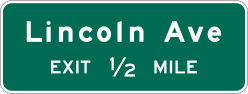
30. You see this interchange advance guide sign one mile before your exit. What does it cue you to do?
- Begin moving toward the right lane while keeping your speed. (correct)
- Slow down in the through lane so you don't miss the exit.
- Exit immediately from whatever lane you happen to be in.
- Change to the left lane to let exiting traffic use the right lane.
Why: An advance guide sign is posted well ahead of the ramp, at two miles, one mile, and half a mile, so you can drift toward the right lane at highway speed. The trap is the answer that reads the mileage as a cue to slow down. That habit comes from surface-street warning signs that really do mean prepare to stop; at highway speed a mile out, braking in the through lane invites a rear-end hit.
Source: Manual on Uniform Traffic Control Devices, sign E1-1 (Interchange Advance Guide Sign).
-
31. On the road ahead you see an area marked with yellow diagonal stripes. What does this area indicate?
- A two-way left turn lane.
- An off-limits area. (correct)
- A passing zone.
- A construction area.
Why: Yellow diagonal stripes within a painted median mark fixed objects ahead or areas where vehicle use is not allowed. It is illegal to drive in or make a turn across these stripes. Treat the striped area as off-limits to all vehicle movement. Drivers drawn to A confuse yellow diagonal stripes (off-limits painted median) with the two-way special left turn lane, another yellow-bordered center area but one they may legally enter to turn.
Source: Oregon Driver Manual, "Pavement Markings," p.23.
-
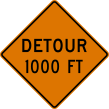
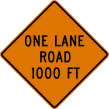
32. What does this orange diamond warning sign tell you about the road ahead?
- One lane about 1,000 feet ahead shared by traffic in both directions. (correct)
- Two lanes merge into one in your direction of travel ahead.
- The road is closed to through traffic 1,000 feet ahead.
- A one-way street begins 1,000 feet ahead.
Why: The sign warns that about 1,000 feet ahead the road narrows to one lane that both directions of traffic must share, so you slow down and prepare to yield to oncoming vehicles or a flagger. The trap is the choice that reads it as a lane-drop merge; a merge sign shows two same-direction lanes joining into one, while this sign specifically warns of two-way traffic sharing a single lane.
Source: Manual on Uniform Traffic Control Devices, sign CW20-4 (One Lane Road 1000 Ft).
-
33. An HOV 2+ ONLY lane is reserved for which vehicles?
- Vehicles carrying at least two or more persons. (correct)
- Vehicles with at least three passengers besides the driver.
- Vehicles operated by public transit agencies.
- Vehicles displaying a state-issued HOV permit.
Why: High Occupancy Vehicle lanes are reserved for vehicles carrying at least the number of people listed on the sign. HOV 2+ means at least two occupants, including the driver. The lane may also be marked with a white diamond on the pavement, and the hours of restriction are usually posted on the sign itself. Drivers who pick B are reading the 2+ as passengers stacked on top of the driver rather than the total number of persons in the vehicle.
Source: Oregon Driver Manual, "Regulatory Signs – Other," p.9.
-
34. What is Oregon's minimum property-damage liability coverage?
- $50,000.
- $15,000.
- $20,000. (correct)
- $25,000.
Why: The Oregon minimum is $20,000 per collision for damage to the property of others. This covers the other vehicle, fences, mailboxes, light poles, or any other property damaged in the collision. It does not cover damage to your own vehicle; that requires collision coverage, which is optional. Drivers arriving from a state where $25,000 is the property-damage floor often pick D by habit instead of checking Oregon's lower figure.
Source: Oregon Driver Manual, "Mandatory Insurance," p.93.
-
35. You hit an unoccupied parked vehicle in an Oregon parking lot. What must you do?
- Wait at the parked vehicle until the owner returns, up to 24 hours.
- Try to find the owner; if you cannot, leave a note with your name, address, and what happened. (correct)
- Drive away; Oregon has no rule about hitting unoccupied vehicles.
- File a collision report with DMV within 72 hours; no note is needed.
Why: First, try to find the owner. If you cannot, leave a note with your name and address along with a brief description of what happened. The duty extends beyond vehicles: for damage to other property, notify the owner or someone in charge. Driving off without a note breaks the rule even when the vehicle is empty. What makes D tempting is a driver carrying the separate 72-hour DMV filing rule over as a substitute for the on-scene duty; the note obligation is its own step and the report does not stand in for it.
Source: Oregon Driver Manual, "Unattended Vehicles," p.94.
Keep going.
Want explanations one question at a time? Browse every Oregon practice question or jump into the topic study guide. Ready to close the gaps for good? Own the Oregon book and its study system.