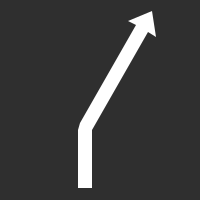
What does this lane-reduction arrow require you to do?
-
A.
Move into the next lane in the direction the arrow points before this lane ends. Correct
-
B.
Turn in the direction the arrow points at the next intersection.
-
C.
Stay in this lane; adjacent traffic must yield so you can merge later.
-
D.
Continue straight; drivers in the adjacent lane must move over into your lane.
The answer is "Move into the next lane in the direction the arrow points before this lane ends."
A lane-reduction arrow warns that your lane is ending, and its bend points at the open lane you must merge into before the pavement runs out. The tempting wrong pick is the turn-arrow reading, since painted arrows on intersection approach lanes usually direct a required turn. But a mandatory-turn arrow runs straight the whole length of its shaft and sits in a dedicated turn pocket, while this arrow bends part-way along a through lane to say the lane itself is going away.
The traps in the wrong answers
B. Turn in the direction the arrow points at the next intersection.
This describes the straight arrow painted in a dedicated turn pocket, which directs a required turn at the intersection ahead rather than a merge. This answer reads the bent through-lane arrow as the straight turn-arrow used in a mandatory-turn pocket.
C. Stay in this lane; adjacent traffic must yield so you can merge later.
The marking puts the burden on the driver whose lane is ending; it does not give that driver priority over traffic already in the next lane. This answer invents a right-of-way rule for the merging driver that the marking does not create.
D. Continue straight; drivers in the adjacent lane must move over into your lane.
The arrow is painted in the lane that is running out, not the lane that continues, so through traffic is not the party doing the merging. This answer reverses the marking by treating the ending lane as the one that stays open.
This question tests your knowledge of Road Markings on the roads of every US state . Source: Manual on Uniform Traffic Control Devices, marking 3B.12 (Lane-Reduction Arrow)..
Related questions
- The blue wheelchair symbol painted on a parking space marks the space as what? →
- A white bicycle symbol painted on the pavement next to a solid white lane line marks the lane as what? →
- The word BIKE is painted in white inside a travel lane. What does this pavement legend identify? →
- A yellow center line has a solid line on your side and a broken line on the side used by oncoming traffic. What does this require of you? →
- A broken white line runs along the right edge of the roadway between the through lane and an exit ramp. What does it permit a driver to do? →