Pennsylvania Practice Test
A full-length practice test for the Pennsylvania PennDOT knowledge test.
18 Questions Click an answer to reveal the explanation








Pennsylvania Practice Test (18 questions). Correct answers and explanations are noted under each question.
-
1. The word STOP is painted in white across your travel lane. What does this pavement legend tell you?
- A stop sign or signal is ahead, and you must prepare to come to a complete stop. (correct)
- The legend itself is the stop line where the front wheels must halt.
- Cross traffic ahead has the right of way at an uncontrolled intersection.
- A rolling stop is allowed when the intersection ahead is clear.
Why: The STOP legend on the pavement reinforces an upcoming stop sign or signal and warns you to prepare to bring the vehicle to a complete stop. The trap is the choice that treats the painted word as the stop line itself; the legend typically appears just before a transverse stop bar, so the line you halt behind is that bar, not the word painted on the approach.
Source: Manual on Uniform Traffic Control Devices, marking 3B.20 (STOP Pavement Legend).
-
2. What does this Fresh Oil sign require of a driver approaching the treated pavement?
- Brake and steer gently and leave extra following distance behind the vehicle ahead. (correct)
- Maintain highway speed since the treatment sets quickly under traffic.
- Stop before entering the treated section and wait for a flagger to wave you through.
- Change to the adjacent lane to avoid driving on the fresh surface.
Why: The sign marks a surface treatment that has just been laid down and has not yet set, so the pavement offers much less grip than it looks like it should. Brake and steer gently, and leave extra following distance so loose chips and oil thrown up by the vehicle ahead don't reach your windshield. The trap is the choice that turns the sign into a flagger cue and stops the driver; every orange work-zone diamond is a hazard warning, not a traffic-control order, and nothing on this one directs a halt.
Source: Manual on Uniform Traffic Control Devices, sign W21-2 (Fresh Oil).
-
3. What does this yellow-green pentagon sign tell you about the road ahead?
- A school zone or school crossing is ahead; slow down and watch for children. (correct)
- A pedestrian crosswalk is ahead; yield to any pedestrian already in the road.
- You are entering a school speed zone; the reduced limit applies whenever you see this sign.
- A stopped school bus with flashing lights is ahead; prepare to stop until the lights go off.
Why: The pentagon shape and fluorescent yellow-green color mark the school advance warning: a school zone or a school crossing is ahead, so slow down and watch for children stepping into the road. The trap is the plain pedestrian-crosswalk reading. Fluorescent yellow-green is also used on general pedestrian warnings, so a driver who keys on color alone and skips over the pentagon outline reaches for the crosswalk answer, when the five-sided shape is reserved for schools.
Source: Manual on Uniform Traffic Control Devices, sign S1-1 (School Advance Warning).
-
4. A lane line becomes a series of closely spaced short white dots through an interchange. What does this dotted pattern tell you about the lane?
- The lane ends at the next intersection and you must change lanes now.
- The lane continues but is shared, dropping, or merging. (correct)
- The lane is reserved for buses or high-occupancy vehicles through the gap.
- You may cross the dotted line only in an emergency.
Why: A dotted white extension line is a lane line continued in short, closely spaced dots through a merge, exit, interchange, or intersection area. The dots tell you the lane keeps going, but its purpose is changing: it is shared with entering traffic, about to drop, or being merged into another lane. Track the dots to stay aligned and watch for cars entering or exiting through the gap. The trap is the answer that reads a broken-up line as a lane-drop warning. A driver who learned that a solid line becomes broken when a lane is ending carries that habit forward and reads any interruption in the striping the same way. The dotted extension does the opposite: it says the lane continues where the normal stripe cannot be drawn, and only the pattern of use is changing.
Source: Manual on Uniform Traffic Control Devices, marking 3B.04 (Dotted White Extension Line).
-
5. After you pass another vehicle on a two-lane road, when should you move back into your lane?
- As soon as your rear bumper passes the other vehicle
- When both its headlights appear in your rearview mirror (correct)
- Right after signaling your intention to move back
- When the passed vehicle flashes its high beams
Why: The manual tells you to wait until you can see both headlights of the passed vehicle in your rearview mirror before moving back over; a rear-bumper feel or a courtesy flash from the other driver is not enough. The rear-bumper cue in A comes from an everyday lane-change habit of gauging clearance by your own bumper rather than by the passed vehicle's headlights in the mirror.
Source: Pennsylvania Driver Manual, "Passing," p.47.
-
6. What does the manual say about the green signal at a ramp-metering light?
- It gives you the right of way onto the highway
- It requires highway traffic to slow and let you merge
- It clears a metered gap in mainline traffic
- It does not protect your entrance; you must still find a safe gap (correct)
Why: The green at a ramp meter does not grant right-of-way; drivers must still find a safe gap in mainline traffic. The pull toward A comes from reading any green signal as automatic permission to proceed, regardless of context.
Source: Pennsylvania Driver Manual, "RAMP-METERING SIGNALS," p.8.
-
7. You approach a vehicle stopped in the road ahead of you. Before you pass it, what does the manual tell you to do?
- Slow down and don't pass until sure no pedestrians are crossing in front of it. (correct)
- Sound your horn and steer wide around the stopped vehicle.
- Treat the vehicle's four-way flashers as your cue to pass.
- Match the speed of nearby lanes and continue past the vehicle.
Why: The manual is specific: a stopped vehicle hides the road in front of it, so slow down and hold back until you have confirmed no pedestrian is stepping across in front of it. Horns, flashers, and speed-matching do nothing to address that hidden pedestrian. B leans on the alert-others horn habit, ignoring that a pedestrian hidden by the stopped car cannot see or react to it in time.
Source: Pennsylvania Driver Manual, "Sharing the Road With Pedestrians, Bicyclists, and Motorcyclists and Moped Drivers - Pedestrians," p.55.
-
8. What does this Divided Highway Begins sign tell a driver about the road ahead?
- Two same-direction lanes ahead merge into a single travel lane.
- The road splits into two separate one-way roadways separated by a median. (correct)
- The divided highway ends ahead and traffic returns to two-way.
- The road ahead ends at a dead end with no through route.
Why: The sign warns that the road splits into two separate one-way roadways separated by a median or barrier, so from that point you keep right of the divider and treat each direction as its own one-way street. The trap is the choice that reads the sign as the divided highway ending and traffic returning to two-way; that meaning belongs to the mirror-image W6-2 sign, whose symbol on the same yellow diamond points the opposite way.
Source: Manual on Uniform Traffic Control Devices, sign W6-1 (Divided Highway Begins).
-
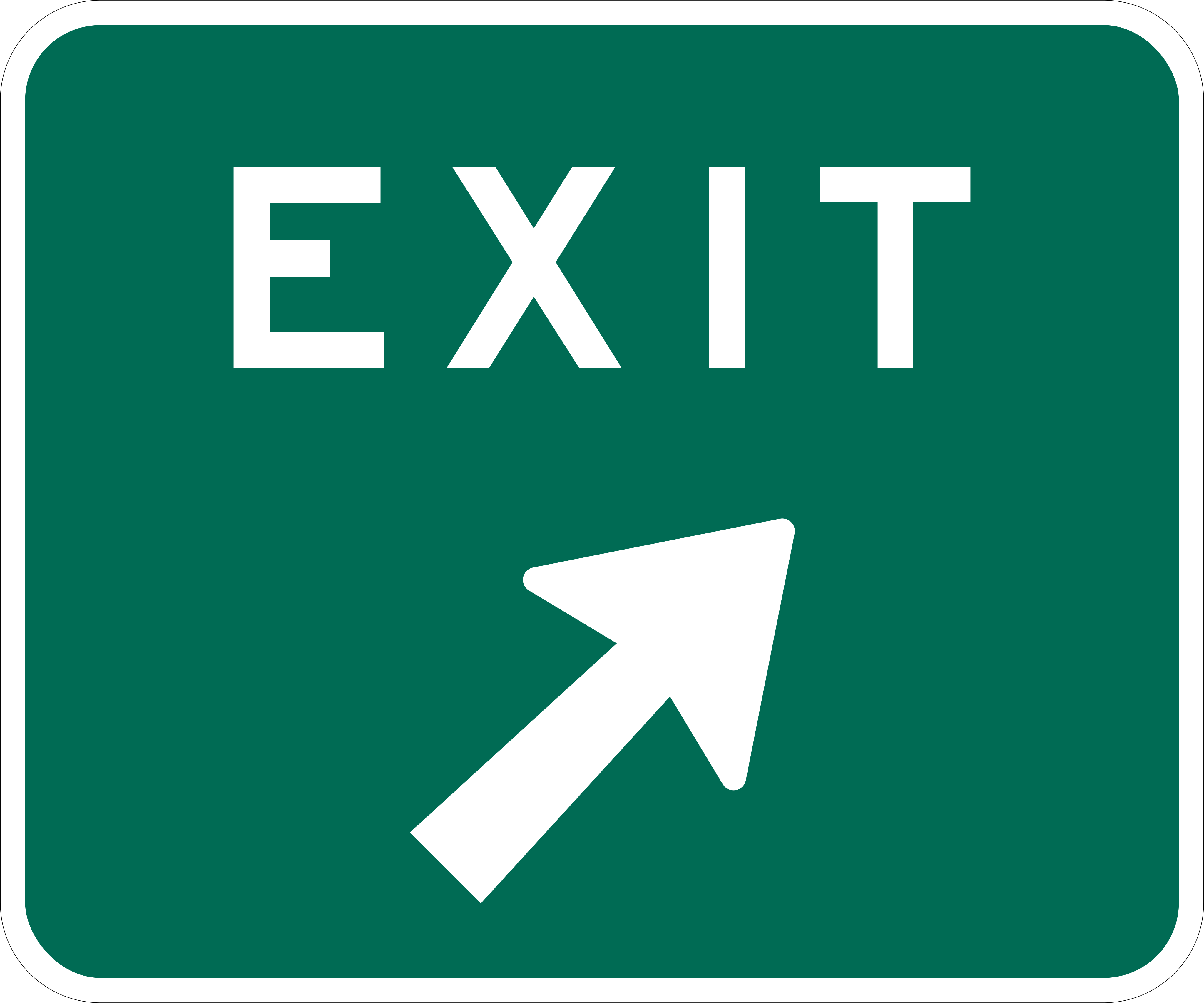
9. What does this Exit Gore sign mark on the freeway?
- It marks the point where the exit ramp separates from the freeway (correct)
- It shows where the exit's deceleration lane begins
- It gives the distance remaining to the next exit
- It posts the advisory speed for the ramp curve
Why: The Exit Gore sign stands in the triangular wedge where the ramp splits from the through lanes, marking the point of departure. Its upward-slanting arrow points along the ramp so drivers can identify the split as it happens, not so they can time a late lane change. The distance-to-next-exit answer tempts drivers who read every green freeway rectangle as a mileage panel, a habit built by the distance signs posted along the mainline rather than by anything a gore marker carries.
Source: Manual on Uniform Traffic Control Devices, sign E5-1 (Exit Gore Sign).
-
10. What does this sign tell a driver about the road ahead?
- A campground for tent camping is available ahead. (correct)
- A roadside rest area is available ahead.
- A picnic area with tables is available ahead.
- A recreational vehicle sanitary dump station is ahead.
Why: A white tent on a blue square is a services sign that marks a campground for tent camping ahead. Drivers who pick the sanitary dump station reach for it because the reference entry lists dump stations as a related facility, but that is a separate device for a different service: this sign promises overnight tent sites.
Source: Manual on Uniform Traffic Control Devices, sign D9-3 (Camping).
-
11. A lane is marked on the pavement with a white arrow that points both left and right. What does this require of a driver in that lane?
- Turn left or turn right; going straight is not allowed. (correct)
- Turn left only, since the left arrow has priority.
- Continue straight or turn, based on traffic conditions.
- Yield to oncoming traffic before choosing a direction.
Why: A two-headed arrow marks a mandatory-turn lane: a driver in that lane must go left or right, and continuing straight is not permitted. The trap is the option that keeps straight on the table as a traffic-dependent choice, which is how a shared through-and-turn lane works. This marking is not shared. The lane is dedicated to turning, and the through movement has been ruled out before the stop bar.
Source: Manual on Uniform Traffic Control Devices, marking 3B.24 (Left-or-Right Turn Arrow).
-
12. At an intersection with a STOP sign, what does the manual tell you to do?
- Stop completely and check for pedestrians and cross traffic (correct)
- Stop only when other vehicles are already in the intersection
- Yield to cross traffic without needing to come to a full stop
- Slow to a rolling speed and continue if no cars are visible
Why: The manual tells you to stop completely, then check for pedestrians and cross traffic before clearing the intersection. Slowing down without a full stop is illegal. A separate sign is sometimes posted with a STOP sign to allow a right turn without stopping, but the STOP sign on its own always requires a full halt. The rolling-stop habit from quiet neighborhood streets pulls drivers toward D, where easing through feels safe whenever the intersection looks empty.
Source: Pennsylvania Driver Manual, "Regulatory Signs," p.10.
-
13. An adult passenger is riding in the bed of your open-bed pickup truck. What is the highest speed the manual allows?
- 25 mph
- 45 mph
- 55 mph
- 35 mph (correct)
Why: The manual sets 35 mph as the highest legal speed when a person is in the bed of an open-bed pickup. A separate sentence bars anyone under 18 from the bed except in narrow farm, hunting, and parade cases, so the question fixes the passenger as an adult. Drivers who pick 55 mph are half-remembering the general highway limit and treating the person in the bed as if they were belted inside the cab.
Source: Pennsylvania Driver Manual, "Passengers in an Open-Bed Truck," p.59.
-
14. The manual prohibits parking within how many feet of a crosswalk at an intersection?
- 50 feet
- 10 feet
- 30 feet
- 20 feet (correct)
Why: Intersection crosswalks get a twenty-foot buffer so drivers approaching the corner can see people stepping into the crosswalk. The parking-distance rules sit together in one bulleted list, and the numbers get swapped when a driver reaches for the wrong entry. The 30 feet in C belongs to the neighboring stop-sign and flashing-signal rule, not the crosswalk one.
Source: Pennsylvania Driver Manual, "Learning to Drive: Parking," p.53.
-
15. What should you do when you approach this Pedestrian Crossing sign?
- Reduce speed and be ready to yield to pedestrians crossing the roadway ahead. (correct)
- Come to a full stop at the sign before continuing through the area.
- Pass the vehicle stopped at the crosswalk if no pedestrian is visible from your lane.
- Slow only when school-aged children are present in the crossing area.
Why: The yellow-green diamond warns that pedestrians may enter the roadway ahead, so slow down and be ready to yield to anyone stepping into or already in the crosswalk. Drivers who fall back on the red-octagon habit of halting at every serious-looking sign pick the come-to-a-full-stop answer instead.
Source: Manual on Uniform Traffic Control Devices, sign W11-2 (Pedestrian Crossing).
-
16. You need to park on a rural road that has no curb. What does the manual tell you to do?
- Leave two wheels on the pavement for visibility.
- Park facing oncoming traffic so drivers can see you.
- Pull as far off the roadway as possible. (correct)
- Stay no more than 12 inches from the pavement edge.
Why: The PARKING section splits its position rule in two: curbed streets get the 12-inch limit, and roads without a curb call for pulling as far off the roadway as possible. B carries over the pedestrian rule about walking against traffic and applies it to a parked vehicle, which the manual does not do.
Source: Pennsylvania Driver Manual, "PARKING," p.52.
-
17. Under which condition does the manual say you may pass another vehicle on the right?
- The vehicle ahead is traveling below the posted speed limit
- You are within 100 feet of an intersection or crossing
- The driver ahead is making or signaling a left turn (correct)
- A solid yellow centerline is on your side of the road
Why: Passing on the right is permitted when the driver ahead is making or signaling a left turn, and the passing vehicle must stay on the berm or shoulder while doing so. The pull toward D comes from reasoning that if a solid yellow line closes off the left side, the right must open up as a workaround, when in fact a solid yellow simply forbids passing.
Source: Pennsylvania Driver Manual, "Passing - Passing on the Right," p.47.
-
18. In which direction must you park on the roadway?
- Facing oncoming traffic
- Either direction, if close to the curb
- In the direction traffic moves (correct)
- Whichever way is more convenient
Why: Pennsylvania requires you to park headed the same way as traffic on your side of the road, whether you have a curb or not. Choice A is the trap: drivers recall that facing oncoming traffic lets them see approaching cars, and mistake that safety instinct for a legal reason to park against the flow.
Source: Pennsylvania Driver Manual, "Learning to Drive: Parking," p.52.
Keep going.
Want explanations one question at a time? Browse every Pennsylvania practice question or jump into the topic study guide. Ready to close the gaps for good? Own the Pennsylvania book and its study system.