North Carolina Practice Test
A 25-question practice test for the North Carolina DMV knowledge test.
25 Questions Click an answer to reveal the explanation





North Carolina Practice Test (25 questions). Correct answers and explanations are noted under each question.
-
1. What does the manual say about using cruise control in the rain?
- Use it to keep a steady speed and reduce fatigue
- Set it 5 mph below the posted limit
- Never use it while it is raining or after it has been raining (correct)
- It is allowed only on interstates with light traffic
Why: The manual tells you never to use cruise control while it is raining or after it has rained, because the time it takes to tap the brake or release cruise can be the difference between keeping and losing control if the car begins to hydroplane. Choice A tempts drivers who carry a dry-highway habit of setting cruise for a steady speed straight into wet weather.
Source: North Carolina Driver Handbook, "Hydroplaning," p.72.
-
2. You are in the left lane and see this sign in a work zone. What does it require of you?
- Signal, match traffic speed in the right lane, and merge right before the taper. (correct)
- Stop at the taper and wait for a gap in traffic before merging.
- Race to the taper and cut in ahead of continuing traffic.
- Stay in the left lane; traffic in the right lane must yield to you.
Why: In a work-zone lane closure, the driver in the ending lane signals, matches the speed of the through lane, and merges right well before the taper. Racing to the taper and cutting in ahead of continuing traffic tempts drivers who treat the closure as a chance to gain position, the aggressive habit this advance warning is placed to prevent.
Source: Manual on Uniform Traffic Control Devices, sign CW4-2L (Lane Ends Merge Right (Work Zone)).
-
3. What does this pavement marking permit a driver in the lane to do?
- Reverse direction with a U-turn at the intersection. (correct)
- Make a left turn only at the intersection.
- Use the lane for left turns from either direction of travel.
- Execute a three-point turn to change direction.
Why: A curved arrow that loops a full 180 degrees marks the lane as one where U-turns are permitted, so a driver may reverse direction at the intersection. The trap sits with the plain left-turn reading: a left-turn arrow bends once toward the left and stops there, while the U-turn arrow wraps the whole way around to show the reversal, and the two markings sit close enough in shape that the loop gets misread as an ordinary left.
Source: Manual on Uniform Traffic Control Devices, marking 3B.24 (U-Turn Arrow).
-
4. According to the manual, what information do guide/informational signs give drivers?
- No U-turn and keep-right lane rules
- Warnings about upcoming road hazards
- Speed limits and enforcement rules
- Directions, routes, distances, and services (correct)
Why: The manual defines guide/informational signs as giving directions, routes, distances, and indicating services, which is the full scope of the category. Choice B is the trap for drivers who sort every roadside sign into just two buckets, regulatory and warning, and expect any sign that "informs" to be handing them a hazard alert.
Source: North Carolina Driver Handbook, "Chapter 5 - Signals and Signs, Guide/Informational Signs," p.85.
-
5. Yellow diagonal stripes inside a solid yellow border fill a rectangle between opposing-direction lanes. What does this require of you?
- Use it as a two-way left-turn lane for turns to either side.
- Do not drive into the striped area. (correct)
- Treat it as a passing zone for opposing traffic.
- Stop inside the stripes before merging into the next lane.
Why: A rectangle outlined in solid yellow and filled with diagonal stripes is a painted median between opposing-direction lanes, and it is closed to travel. The trap is the two-way left-turn lane, which also sits between opposing traffic and uses yellow paint; a driver who learned that rule first carries it over. But a two-way left-turn lane is bounded by a solid outer yellow and a broken inner yellow with no diagonal fill, and it exists to be entered for turns. The diagonal stripes flag pavement not meant for any travel at all.
Source: Manual on Uniform Traffic Control Devices, marking 3B.25 (Yellow Diagonal Crosshatch (Neutral Median Area)).
-
6. If DMV is notified that a vehicle owner is operating without proper liability insurance, how long can the vehicle's license plate be revoked?
- 10 days
- 60 days
- 30 days (correct)
- 90 days
Why: When DMV learns a vehicle is being driven without required liability coverage, the license plate can be revoked for 30 days unless the owner shows continuous coverage. The 60-day figure matches the first-offense driver-license suspension length from the point system printed a few chapters earlier, and drivers mix the two windows up.
Source: North Carolina Driver Handbook, "Insurance and Financial Responsibility," p.99.
-
7. How often does the manual say to check your mirrors while driving?
- About every 10 seconds (correct)
- Only when planning a lane change
- Once every minute in traffic
- Only when braking is likely
Why: The manual sets a 10-second cadence for mirror checks, separate from the checks you do before a maneuver. New drivers used to glancing only when planning a lane change reach for choice B because it matches how they were taught to use mirrors in driver's ed, but the rule describes an ongoing background check.
Source: North Carolina Driver Handbook, "Defensive Driving - Scanning," p.68.
-
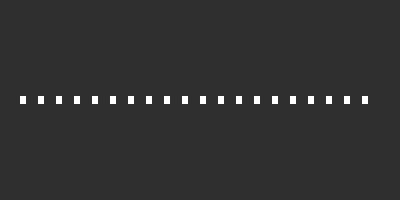
8. A lane line becomes a series of closely spaced short white dots through an interchange. What does this dotted pattern tell you about the lane?
- The lane ends at the next intersection and you must change lanes now.
- The lane continues but is shared, dropping, or merging. (correct)
- The lane is reserved for buses or high-occupancy vehicles through the gap.
- You may cross the dotted line only in an emergency.
Why: A dotted white extension line is a lane line continued in short, closely spaced dots through a merge, exit, interchange, or intersection area. The dots tell you the lane keeps going, but its purpose is changing: it is shared with entering traffic, about to drop, or being merged into another lane. Track the dots to stay aligned and watch for cars entering or exiting through the gap. The trap is the answer that reads a broken-up line as a lane-drop warning. A driver who learned that a solid line becomes broken when a lane is ending carries that habit forward and reads any interruption in the striping the same way. The dotted extension does the opposite: it says the lane continues where the normal stripe cannot be drawn, and only the pattern of use is changing.
Source: Manual on Uniform Traffic Control Devices, marking 3B.04 (Dotted White Extension Line).
-
9. This pavement marking is painted across your lane at a stop-controlled intersection. Where must you bring your vehicle to a stop?
- Before any part of the vehicle crosses the line. (correct)
- With the front bumper directly over the line.
- At the curb of the cross street.
- Anywhere within one car length past the line.
Why: The stop line marks the exact boundary the vehicle must remain behind at a stop sign or red signal; the entry says to bring the front of the vehicle to a complete halt before any part of it crosses the line. The tempting wrong pick is stopping with the bumper directly over the line: drivers read the bar as a target to line up with rather than a boundary they may not cross, so they pull forward until the front wheel or bumper rests on the paint.
Source: Manual on Uniform Traffic Control Devices, marking 3B.16 (Stop Line).
-
10. You are approaching a turn on a street with a posted 35 mph limit. How far ahead of the turn must your signal be on?
- 200 feet, the same as at highway speeds.
- 100 feet, the minimum for a turn or stop at this speed. (correct)
- 50 feet, roughly a car length per 10 mph.
- Just before the turn, so drivers behind do not slow early.
Why: Under 45 mph, the required signal distance is at least the last 100 feet before turning or stopping. Choice A is the confused-with-highway trap: 200 feet is the rule when the limit's 45 mph or more, and drivers who lock onto one number often apply it at every speed.
Source: North Carolina Driver Handbook, "Flashing Turn Signals," p.69.
-
11. In a single-lane roundabout, how far around do you travel before exiting when making a left turn?
- Three-quarters around, then exit to the right. (correct)
- A quarter of the way, for a right turn at the next street.
- Halfway around, the same as if going straight.
- A full circle around, the same as a U-turn.
Why: In a single-lane roundabout, a left turn is made by traveling three-quarters of the way around and exiting to the right. Choice B is the reflex for drivers used to a left going left first; a quarter turn in a roundabout is actually a right at the next street.
Source: North Carolina Driver Handbook, "Single-Lane Roundabout," p.59.
-
12. According to the manual, N.C. secondary road signs use which shape?
- Rectangle (correct)
- Diamond
- Shield
- Pentagon
Why: The manual identifies N.C. secondary road signs specifically as rectangular. The trap is diamond, the shape the manual assigns to N.C. state route markers on the entry printed just above the secondary road one.
Source: North Carolina Driver Handbook, "Guide/Informational Signs," p.85.
-
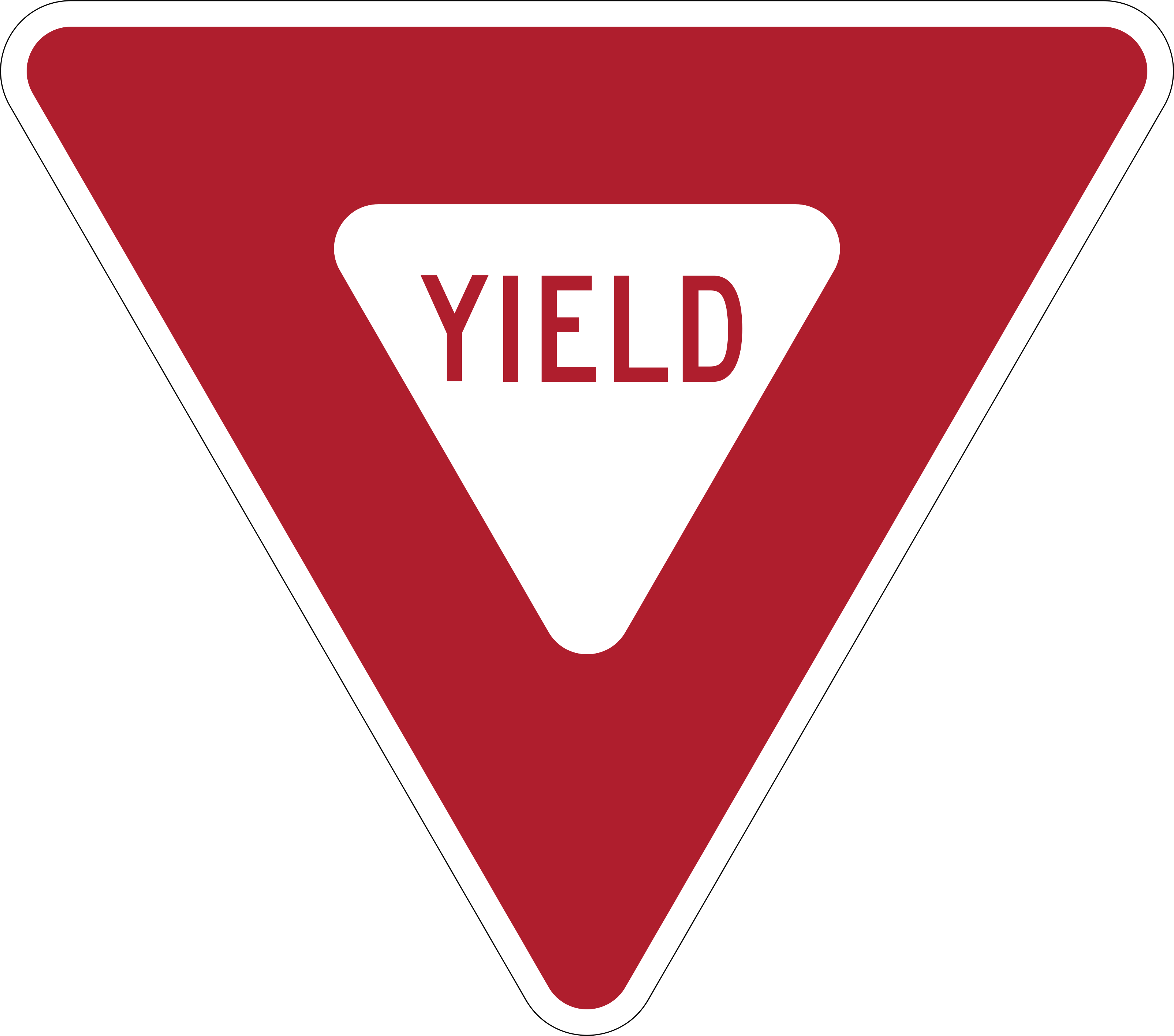
13. What does this yield sign require of a driver approaching it?
- Slow down, give the right-of-way to cross traffic and pedestrians, and stop if needed. (correct)
- Stop completely at the line every time before entering the intersection.
- Speed up through the intersection to clear it before cross traffic arrives.
- Continue at the posted speed unless a signal or officer directs otherwise.
Why: A yield sign asks a driver to slow, scan for cross traffic and pedestrians, and stop only when someone else has the right-of-way; if the way is clear, the driver may roll through without stopping. The trap is the answer that turns the triangle into a stop sign because both signs are red, but the octagon demands a halt every time and the downward triangle demands one only when a conflict is present.
Source: Manual on Uniform Traffic Control Devices, sign R1-2 (Yield).
-
14. In North Carolina, state route markers are what shape?
- Rectangle
- Diamond (correct)
- Shield
- Circle
Why: North Carolina state route markers are diamond-shaped, which sets them apart from U.S. and Interstate shields. Choice C is the tempting miss because both Interstate and U.S. numbered highways use a shield, so a driver who defaults to a highway-equals-shield rule misses the state's own shape.
Source: North Carolina Driver Handbook, "Chapter 5, Signals and Signs, Guide/Informational Signs," p.85.
-
15. For an applicant age 18 or older who does not qualify for the Modernization Act RID exception, how many proofs of North Carolina residency does NCDMV require?
- One
- Three
- Two (correct)
- Four
Why: Adults 18 or older must show two proofs of North Carolina residency; only one proof is required when the applicant qualifies for the Modernization Act RID exception, which this prompt excludes. Choice A tempts readers who skimmed the paragraph and carried the single-proof RID rule over to the general adult application.
Source: North Carolina Driver Handbook, "Chapter 1 - Your License, Table (3) Proof of Residency Requirements for Adults 18 or Over," p.19.
-
16. When driving unsupervised on a Level Two Limited Provisional License, with no under-21 household members in the vehicle, how many non-household passengers under 21 may you carry (setting aside the narrow school-transport exception)?
- Any number of teens as long as one adult is present
- None; the passenger seat must be empty
- One passenger under 21 not in your household (correct)
- Up to three passengers, provided they are all students
Why: A Level Two driver operating unsupervised may carry one passenger under 21 who is not a household member, and under-21 household members may not ride at the same time as any under-21 non-household passenger. The manual carves out one additional under-21 non-household rider only when that rider is a student being driven directly to or from school. Choice D is the trap for drivers who read the student carve-out as general permission to carpool classmates, when the manual grants it only for direct school transport of a single additional rider.
Source: North Carolina Driver Handbook, "Level Two Limited Provisional License," p.13.
-
17. According to the manual, what can cause headlights to become out of adjustment?
- Vehicle vibration (correct)
- Long exposure to sunlight
- Frequent use of high beams
- Cold winter temperatures
Why: The manual says vehicle vibration can cause the headlights to become out of adjustment, which is why it recommends routinely checking and adjusting the aim. Drivers who pick D are carrying over the cold-weather checklist they use for tire pressure and battery output and assume the headlight mount drifts the same way.
Source: North Carolina Driver Handbook, "Vehicle Equipment - Lights," p.65.
-
18. When using low-beam headlights, how far away should you be able to see a person?
- 75 feet (correct)
- 150 feet
- 200 feet
- 50 feet
Why: The manual sets 75 feet as the low-beam visibility standard. Drivers who pick 200 feet are grabbing the high-beam figure the manual gives in the same bullet and applying it to the wrong beam.
Source: North Carolina Driver Handbook, "Vehicle Equipment - Lights," p.65.
-
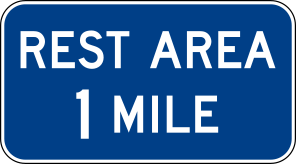
19. What does this Rest Area sign tell a driver?
- The distance to the next rest area ahead. (correct)
- That a rest area entrance is at this location.
- That vehicles may pull onto the road from a shoulder ahead.
- The gas and food brands available at the coming exit.
Why: A blue rectangular Rest Area advance sign posts how far ahead the next rest area is, so you can plan whether to pull off in time. The pick that reads the sign as the entrance itself confuses this advance version with the ramp-mouth sign at the actual driveway; the advance sign is set back so drivers still have room to slow, signal, and exit.
Source: Manual on Uniform Traffic Control Devices, sign D5-1 (Rest Area Advance).
-
20. A train has just cleared a railroad crossing where you were stopped. What does the manual tell you to do?
- Sound your horn once and then proceed.
- Wait before moving in case another train is coming. (correct)
- Follow the vehicle ahead once it starts.
- Cross as soon as the last car passes.
Why: The manual says not to move immediately after a train has passed, because another train may be following or coming from the other direction on an adjacent track. Option D is the pull for drivers working from the rule of thumb that the back of the last car means the crossing is clear.
Source: North Carolina Driver Handbook, "Railroad Crossing Safety," p.61.
-
21. What does this sign tell a driver about the road ahead?
- A campground for tent camping is available ahead. (correct)
- A roadside rest area is available ahead.
- A picnic area with tables is available ahead.
- A recreational vehicle sanitary dump station is ahead.
Why: A white tent on a blue square is a services sign that marks a campground for tent camping ahead. Drivers who pick the sanitary dump station reach for it because the reference entry lists dump stations as a related facility, but that is a separate device for a different service: this sign promises overnight tent sites.
Source: Manual on Uniform Traffic Control Devices, sign D9-3 (Camping).
-
22. A solid yellow line in your lane tells you what?
- Pass only during daylight hours.
- You may pass if the road ahead looks clear.
- You may not pass another vehicle. (correct)
- Pass only if the vehicle ahead is slower.
Why: A solid yellow line on your side of the road marks a no-passing zone, and the manual flatly says passing there is illegal. Choice B is the trap: drivers lean on the habit of judging every pass by how far they can see ahead, and treat a clear-looking view as permission to cross paint that forbids it.
Source: North Carolina Driver Handbook, "Passing," p.51.
-
23. A supervising driver for a Level One or Level Two licensee must have been licensed for at least how many years?
- Three years
- Ten years
- Five years (correct)
- Two years
Why: North Carolina requires a supervising driver to hold a valid license and have been licensed for at least five years. Drivers who learned in a state with a shorter supervisor rule often carry the lower minimum over and pick D.
Source: North Carolina Driver Handbook, "Level Two Limited Provisional License, Supervising Driver," p.13.
-
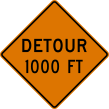
24. What does this Detour Ahead sign tell a driver about the road ahead?
- The road ahead is closed and traffic will follow a marked detour route. (correct)
- One lane ahead is closed but the road stays open to through traffic.
- A flagger is directing traffic through the work zone ahead.
- Workers are on or near the shoulder in the work zone ahead.
Why: W20-2 warns that the road ahead is closed and traffic is sent around the work zone on a marked detour, so past this point you stop navigating by memory and start reading the orange DETOUR markers. The pull toward the lane-closure answer comes from drivers who've mostly met work-zone signs that shift traffic within the same road; the detour warning is used when the through route itself is shut, not narrowed.
Source: Manual on Uniform Traffic Control Devices, sign W20-2 (Detour Ahead).
-
25. You are following a tractor-trailer and want to pass. What does the manual say to do first?
- Move to the shoulder for a wider view of the road ahead
- Observe the truck's turn signals before attempting to pass (correct)
- Blow your horn twice to alert the truck driver
- Flash your headlights to signal your intent to pass
Why: Large trucks swing wide, and a driver setting up a right turn may drift left first, so the manual tells you to read the truck's turn signals before you commit to a pass. The 'horn twice' trap pulls in the general passing procedure printed elsewhere in the manual, where alerting a slower vehicle is part of the sequence, but that step does not replace the turn-signal check a truck needs.
Source: North Carolina Driver Handbook, "Trucks and Other Vehicles," p.91.
Keep going.
Want explanations one question at a time? Browse every North Carolina practice question or jump into the topic study guide. Ready to close the gaps for good? Own the North Carolina book and its study system.