New York Practice Test
A full-length practice test for the New York DMV knowledge test.
20 Questions Click an answer to reveal the explanation





New York Practice Test (20 questions). Correct answers and explanations are noted under each question.
-
1. What does this yellow-green pentagon sign tell you about the road ahead?
- A school zone or school crossing is ahead; slow down and watch for children. (correct)
- A pedestrian crosswalk is ahead; yield to any pedestrian already in the road.
- You are entering a school speed zone; the reduced limit applies whenever you see this sign.
- A stopped school bus with flashing lights is ahead; prepare to stop until the lights go off.
Why: The pentagon shape and fluorescent yellow-green color mark the school advance warning: a school zone or a school crossing is ahead, so slow down and watch for children stepping into the road. The trap is the plain pedestrian-crosswalk reading. Fluorescent yellow-green is also used on general pedestrian warnings, so a driver who keys on color alone and skips over the pentagon outline reaches for the crosswalk answer, when the five-sided shape is reserved for schools.
Source: Manual on Uniform Traffic Control Devices, sign S1-1 (School Advance Warning).
-
2. A yellow warning sign is sometimes joined with a smaller yellow-and-black sign that shows a number. What does that number tell you?
- The distance in feet to the hazard ahead
- The recommended reduced speed for the area ahead (correct)
- The maximum legal speed limit for the area ahead
- The minimum legal speed required in the area
Why: The smaller yellow-and-black plate is an advisory: it names the reduced speed suggested for the hazard the warning sign flags, not an enforced limit. Choice C is the trap for a driver used to black-on-white regulatory speed limit signs; yellow-and-black is advisory, so the number is a suggestion for the curve or condition ahead rather than a legal maximum.
Source: New York State Driver's Manual, "Warning Signs," p.30.
-
3. Your registration expiration falls on a Sunday, and the DMV automatically extends it to Monday. What must you keep active during that extension?
- A paper temporary registration from a DMV office
- A notarized copy of your renewal application
- A parking-ticket clearance letter from the county
- Liability insurance on your vehicle (correct)
Why: The automatic weekend extension moves the registration deadline, but the manual tells you to keep liability insurance active during the extension. A driver reaching for a paper temporary registration is treating this like a lapsed-registration situation the extension is designed to avoid in the first place.
Source: New York State Driver's Manual, "Registration Renewal," p.26.
-
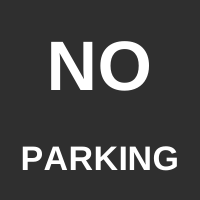
4. A white 'NO PARKING' legend is painted on the pavement along the curb ahead. What does it require of you?
- Park briefly if you leave your hazard lights on.
- Do not park a vehicle in that space. (correct)
- Park there outside posted business hours.
- The prohibition applies only during posted rush hours.
Why: The painted NO PARKING legend means you cannot park a vehicle in that space; treat it the same way you would a posted No Parking sign. The idea that flashing hazard lights buy you a quick stop is borrowed from delivery vans double-parking, and the painted word does not read blinkers.
Source: Manual on Uniform Traffic Control Devices, marking 3B.20 ("No Parking" Pavement Word Marking).
-
5. What does this yellow diamond sign warn of ahead?
- A single sharp curve that bends to the right.
- Three or more curves ahead, first one to the right. (correct)
- Two curves in opposite directions, starting with a bend to the right.
- A right-hand turn at an intersection ahead.
Why: The sign warns of a series of three or more curves ahead, and the first one bends to the right. Reduce speed before the first curve and stay ready for steering reversals through the whole stretch. The two-bend answer catches drivers who read the S-shape symbol as a reverse curve, the pattern carried by the W1-4R Reverse Curve sign, which caps at exactly two bends.
Source: Manual on Uniform Traffic Control Devices, sign W1-5R (Winding Road (Right)).
-
6. Under New York law, when may a driver use a hands-free mobile telephone?
- Only during declared emergencies.
- Only while stopped at a red light.
- At any time behind the wheel. (correct)
- Only after age 21.
Why: The manual states that a hands-free telephone is legal at any time behind the wheel: no age, hour, or situation restriction attaches to it. Choice B is the trap for drivers who carry over the 'text at a red light' habit from other contexts, but the red-light carve-out is not in the manual for calls either. Hands-free is fully legal, and the exception was never needed.
Source: New York State Driver's Manual, "Using a Cellular or Mobile Telephone," p.52.
-
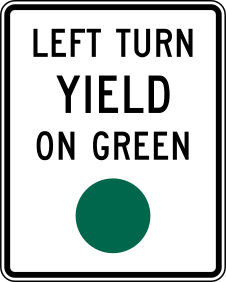
7. What does this sign require of a driver turning left when the signal shows a solid green ball?
- Yield to oncoming traffic before completing the turn. (correct)
- Come to a full stop at the line, then turn when clear.
- Turn without yielding, because the green ball protects the turn.
- Wait for a green arrow; the circular green does not allow a left turn.
Why: The placard restates the permissive left-turn rule: on a circular green ball, a driver may turn left but must first wait for a safe gap in oncoming traffic. The trap is the choice that treats the green ball as a protected turn, which is what a green arrow does; the placard is posted precisely because the ball does not protect the turn.
Source: Manual on Uniform Traffic Control Devices, sign R10-12 (Left Turn Yield on Green).
-
8. Your rear wheels start to slide to the left on ice. Which way should you turn the steering wheel?
- To the left, the direction the vehicle is trying to go (correct)
- To the right, opposite the direction of the skid
- Straight ahead, and hold that position
- Sharply toward the shoulder to stop the slide
Why: For a rear-wheel skid, steer in the direction the vehicle is trying to go. If the rear slides left, steer left. B is the trap: a driver used to 'correcting' by opposing the slide picks the mirror-image direction, which is the exact reflex the steer-into-the-skid rule exists to override.
Source: New York State Driver's Manual, "Chapter 10 - How to Drive in Winter," p.64.
-
9. You are approaching construction equipment that displays the reflective orange slow-moving vehicle triangle. What does the manual say to do?
- Use caution and make sure it is safe before you pass (correct)
- Pass immediately on the right shoulder
- Follow within one car length until the vehicle turns off
- Sound your horn and pass without slowing
Why: The manual says to use caution when approaching a slow-moving vehicle and to make sure it is safe before you pass. Choice C is the trap for drivers who default to a close-following habit on divided highways, but the speed gap the triangle warns about shrinks your following distance the moment you close on the vehicle.
Source: New York State Driver's Manual, "Chapter 11 – Sharing the Road: Slow-Moving Vehicles," p.76.
-
10. An extra-wide solid white line runs along the right side of the roadway. What does it tell you as a driver?
- Keep the line on your left and stay off the shoulder. (correct)
- Cross the line to pass slower traffic on the right.
- Stop your vehicle before crossing the line ahead.
- The lane is reserved for bicycles only.
Why: An extra-wide solid white edge line marks where the travel lane ends on the right, and the driver keeps it on the left while treating the shoulder beyond it as off-limits for normal driving. The tempting wrong choice reads the line as a broken lane divider that a driver may cross to move right, a rule that belongs to dashed white lines between two through lanes, not to an edge line whose whole job is to mark the outer boundary of the lane you are already in.
Source: Manual on Uniform Traffic Control Devices, marking 3B.06 (Wide Solid White Edge Line).
-
11. You reach an intersection with no signs or signals at the same time as another vehicle approaching from your right. Under the manual, who must yield?
- Neither driver has the right of way; both must stop and wave one another through before proceeding.
- Whichever driver is going straight has priority over a turning driver.
- The driver on the left must yield to the driver on the right. (correct)
- Whichever driver arrived at the intersection first can proceed first.
Why: When two drivers reach an uncontrolled intersection at the same time at right angles, the driver on the left yields to the driver on the right. Readers who pick D carry over the four-way STOP habit of first-come, first-served, and apply it here even though the prompt says both vehicles arrived together.
Source: New York State Driver's Manual, "Chapter 5 / Intersections and Turns: Right-of-Way," p.34.
-
12. Why does the New York State Driver's Manual prefer the word "crash" over "accident" for traffic incidents?
- State insurance law now requires the term on all reports.
- Federal highway rules bar the older term in state manuals.
- It signals that the event could normally have been prevented. (correct)
- The term "accident" now refers only to non-vehicle events.
Why: The manual replaces "accident" with "crash" because a crash can normally be prevented; the framing places responsibility on driver choices rather than random chance. Choice A tempts readers who reach for a statute whenever an official document changes its wording, when the reason on the manual page is about prevention, not about legal reporting.
Source: New York State Driver's Manual, "Traffic Crashes," p.22.
-
13. You are involved in a traffic crash in which another person is killed. What can happen to your license?
- It is revoked automatically for one full year with no hearing.
- It cannot be touched until any related criminal case is finished.
- It is safe from action unless you are convicted of a violation.
- DMV can suspend or revoke it after a hearing, even without any charge. (correct)
Why: The manual makes clear that DMV can suspend or revoke your license after its own hearing even if you were never charged with a violation at the scene. Choice C tempts readers who treat a criminal conviction as the only path to license loss, missing that DMV runs an administrative track that does not depend on the courts.
Source: New York State Driver's Manual, "Traffic Crashes," p.22.
-
14. What color are service signs?
- Green with white letters
- Blue with white letters or symbols (correct)
- Yellow with black symbols
- Orange with black letters
Why: Service signs are blue with white letters or symbols and mark rest areas, gas stations, camping, and medical facilities. Picking orange in D reaches for the color a driver learns first to notice at the roadside, so any panel flagging something off the pavement gets sorted there.
Source: New York State Driver's Manual, "Service Signs," p.30.
-
15. A lane is marked with this straight-or-right combination arrow. What does it permit a driver in that lane to do?
- Continue straight through the intersection or turn right. (correct)
- The lane is a right-turn-only lane; you must turn right.
- You must go straight; turning right from this lane is not allowed.
- Continue straight, turn right, or make a U-turn.
Why: The combination arrow marks an optional-movement lane: a driver may either continue straight through the intersection or turn right from the same lane. The tempting wrong pick is the right-turn-only reading, which comes from treating the second arrowhead as if it were a standalone right-turn arrow and ignoring the straight shaft paired with it.
Source: Manual on Uniform Traffic Control Devices, marking 3B.23 (Straight-or-Right Combination Arrow).
-
16. For how long is your first New York driver license issued?
- Ten years, matching an adult passport term.
- Three years from the date of issue.
- Up to 5 years, on your month and day of birth. (correct)
- Eight years, matching the standard adult renewal length.
Why: A first New York driver license is issued for up to five years, ending on your month and day of birth. Drivers who pick ten years are borrowing the term of a U.S. adult passport, which does not set how long a New York license runs.
Source: New York State Driver's Manual, "When You Apply for Your First License," p.8.
-
17. Your lane is separated from the next lane by two lines: a solid line closer to you and a broken line beyond it. What are you allowed to do?
- Cross the line only for a left turn into a driveway (correct)
- Change lanes only during daylight hours
- Cross the line whenever no oncoming traffic is visible
- Pass another vehicle when it is safe to do so
Why: With a solid line on your side and a broken line beyond it, you cannot pass or cross except to make a left turn into a driveway. Choice D is the trap for a driver who reads the pair as a passing zone and applies the broken-line permission from the far side to their own lane.
Source: New York State Driver's Manual, "Lane Markings: Solid line with broken line," p.32.
-
18. A series of wide white bars is painted across the road, parallel to the direction of traffic, like piano keys. What does this marking indicate?
- A high-visibility pedestrian crosswalk. (correct)
- A stop line telling drivers where to halt at the intersection.
- A yield line telling drivers to slow and give way.
- A rumble strip designed to alert drowsy drivers.
Why: A series of wide white bars painted across the road, parallel to the direction of traffic, marks a continental crosswalk, a high-visibility pedestrian crossing. Drivers must yield to pedestrians within it, must not stop on or block the bars, and must not pass another vehicle stopped for someone in the crossing. The stop-line answer comes from confusing these parallel bars with the single perpendicular white line at an intersection that tells drivers where to halt; the two markings run in different directions and carry different meanings.
Source: Manual on Uniform Traffic Control Devices, marking 3B.18 (Continental Crosswalk).
-
19. The manual gives one general meaning for the whole family of yellow warning signs. Where does that entry tell you to look for the specific hazard or rule marked by any one warning sign?
- In the number printed on the yellow-and-black recommended-speed tab
- In the sample signs shown next to the entry (correct)
- In the color of the warning sign only
- In a separate booklet the DMV mails with your learner permit
Why: The manual states one general meaning for the yellow-diamond family (a hazardous location or a special rule) and points to the sample signs printed alongside the entry for what any given sign marks. Choice A is the trap: the advisory-speed tab is introduced two sentences later in the same paragraph, so a learner scanning for a specific-meaning source can lift that tab into the role. The tab shows a recommended speed for an area, never a code for the type of hazard.
Source: New York State Driver's Manual, "Warning Signs," p.30.
-
20. According to the New York manual, what defines a hands-free mobile telephone?
- It requires only one hand to hold during the conversation.
- It communicates without the use of either hand. (correct)
- It uses voice-to-text technology instead of a keypad.
- It runs on the vehicle's Bluetooth system rather than the phone's battery.
Why: The manual defines a hands-free phone by what the driver's hands are doing: you communicate without using either hand. Choice C is the trap for readers who file 'hands-free' next to 'voice-controlled' from newer phone features, but the manual's test is about whether hands are on the device, not about how the words get delivered.
Source: New York State Driver's Manual, "Using a Cellular or Mobile Telephone," p.52.
Keep going.
Want explanations one question at a time? Browse every New York practice question or jump into the topic study guide. Ready to close the gaps for good? Own the New York book and its study system.