Nevada Practice Test
A full-length practice test for the Nevada DMV knowledge test.
25 Questions Click an answer to reveal the explanation









Nevada Practice Test (25 questions). Correct answers and explanations are noted under each question.
-
1. A series of wide white bars is painted across the road, parallel to the direction of traffic, like piano keys. What does this marking indicate?
- A high-visibility pedestrian crosswalk. (correct)
- A stop line telling drivers where to halt at the intersection.
- A yield line telling drivers to slow and give way.
- A rumble strip designed to alert drowsy drivers.
Why: A series of wide white bars painted across the road, parallel to the direction of traffic, marks a continental crosswalk, a high-visibility pedestrian crossing. Drivers must yield to pedestrians within it, must not stop on or block the bars, and must not pass another vehicle stopped for someone in the crossing. The stop-line answer comes from confusing these parallel bars with the single perpendicular white line at an intersection that tells drivers where to halt; the two markings run in different directions and carry different meanings.
Source: Manual on Uniform Traffic Control Devices, marking 3B.18 (Continental Crosswalk).
-
2. When your vehicle is parked in Nevada, how far should it be visible in each direction?
- 300 feet, or about 30 car lengths.
- 200 feet, or about 20 car lengths. (correct)
- 50 feet, or about 5 car lengths.
- 100 feet, or about 10 car lengths.
Why: The Nevada handbook says your parked vehicle should be visible for 200 feet, or about 20 car lengths, in each direction. That gives approaching traffic time to react and pass safely. Learners often confuse this distance with signal-ahead distances (100 feet in cities, 300 feet on highways) or with the 50-foot no-parking zone next to a railroad. The visibility distance is 200 feet.
Source: Nevada Driver Manual, "Parking: general rules," p.48.
-
3. You are about to make a left turn on a two-way Nevada road. Which lane must you start the turn from?
- The far right lane on your side of the road
- The lane just to the right of the center line (correct)
- Any lane, as long as you signal your intent
- The oncoming lane just to the left of the center line
Why: For a left turn on a two-way road, the manual specifies the lane just to the right of the center line. Starting from a far right lane, from any lane at will, or from the oncoming side of the center line is not authorized. This tests learners who know left-turn direction but not the specific starting lane.
Source: Nevada Driver Manual, "Signaling, Turning, Lane Changes, and Passing – Turning," p.45.
-
4. What does this Lodging sign tell a driver?
- A hotel, motel, or other overnight lodging is available ahead. (correct)
- A public rest area with restrooms is available ahead.
- A restaurant or food service is available ahead.
- A campground for overnight camping is available ahead.
Why: The blue Lodging services sign marks a hotel, motel, or other overnight lodging near the exit ahead. The choice pointing to a rest area is the trap because both signs are blue services panels, and a driver who does not check the pictograph reaches for the roadside stop a highway traveler uses more often. The person-lying-in-a-bed pictograph separates them: it signals a paid room for the night, not a roadside pull-out.
Source: Manual on Uniform Traffic Control Devices, sign D9-9 (Lodging).
-
5. The Nevada manual's Basic Rule tells drivers to weigh the type of road. Which road characteristic does the manual specifically list?
- Whether it has a bike lane or bus lane
- Whether it is flat and straight or steep and curvy (correct)
- Whether the pavement is asphalt or concrete
- Whether the road is public or private
Why: Under the Basic Rule's 'type of road' factor, the manual names two paired characteristics: whether the road is flat and straight or steep and curvy, and whether it is wide or narrow. Pavement material, roadway ownership, and lane markings are outside the road-type factors the manual names.
Source: Nevada Driver Manual, "Controlling Speed," p.35.
-
6. What does a white painted curb usually mean in Nevada?
- Limited-time parking as posted on a nearby sign.
- A very short stop for passengers or dropping off mail. (correct)
- Loading zone for freight and commercial vehicles.
- Handicapped-only parking spaces for placard holders.
Why: Nevada uses color-coded curbs to signal parking rules. White curbs allow only a very short stop to pick up or drop off passengers or to drop mail in a mailbox. Green, yellow, red, and blue curbs each carry their own meaning, and mixing them up is the most common trap on this type of question. Anchor the white curb to a quick, purposeful pause, not to any form of extended parking.
Source: Nevada Driver Manual, "Parking: Colored Curb Markings," p.48.
-
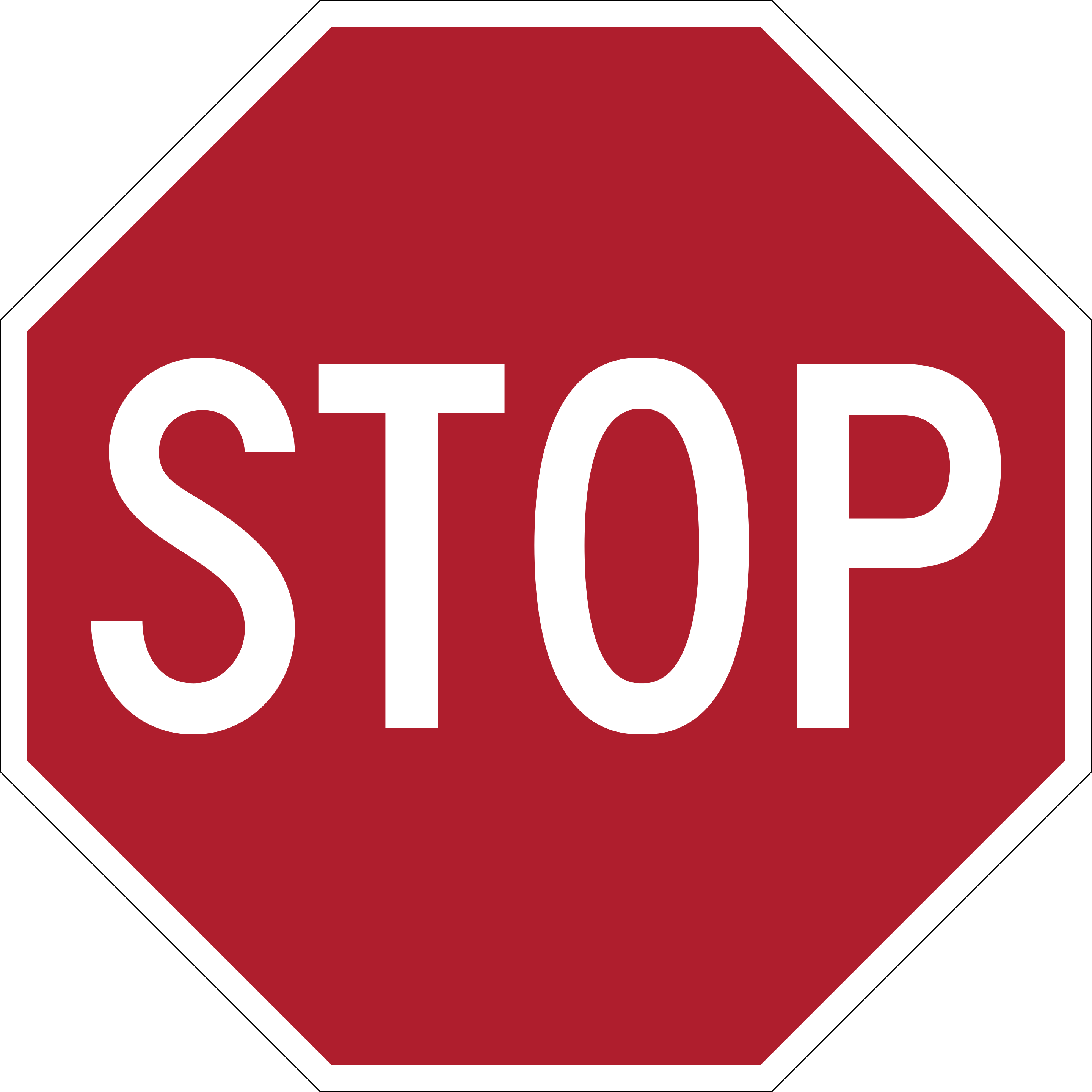
7. After the wheels have fully stopped at a stop sign, when may the driver proceed?
- After yielding to pedestrians and cross traffic with the right-of-way (correct)
- As soon as the vehicle's wheels have fully halted
- When a traffic light or officer waves the driver through
- After the driver on the right has gone first
Why: The stop is only the first step; after halting, drivers yield to pedestrians and any cross traffic that already has the right-of-way, then move when the way is clear. Drivers who learned "stop means stop" as the whole rule pull forward the moment the wheels halt and skip the yield step the octagon requires next.
Source: Manual on Uniform Traffic Control Devices, sign R1-1 (Stop).
-
8. Based on time of day alone, when does Nevada law require you to turn on your headlights?
- From one hour after sunset until one hour before sunrise.
- Only after complete darkness has settled in.
- From a half hour after sunset until a half hour before sunrise. (correct)
- From sunset until sunrise each day.
Why: Nevada's time-of-day rule begins a half hour after sunset and ends a half hour before sunrise. Inside that window, headlights are legally required, regardless of how much light you personally can still see. Nevada also lists separate triggers for insufficient light and for conditions where people or vehicles cannot be clearly seen at 1,000 feet, but the clock-based rule is fixed to sunset and sunrise.
Source: Nevada Driver Manual, "Chapter 5 - Special Driving Conditions: Night Driving," p.56.
-
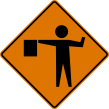
9. You pass a Flagger Ahead sign and enter the work zone. A flagger in the zone waves you through the intersection while the traffic light ahead shows red. What are you required to do?
- Stop for the red light; the traffic light has final authority.
- Follow the flagger's signal and proceed through the intersection. (correct)
- Stop and wait until the signal turns green, then proceed.
- Proceed only if the flagger and the signal both permit it.
Why: A flagger's directions legally override even a traffic light, so when the flagger in the work zone waves you through, you drive past the red. Drivers who stop for the red anyway fall back on the everyday rule that a steady red is always absolute, and miss that the orange diamond warned of a flagger whose directions now outrank the light.
Source: Manual on Uniform Traffic Control Devices, sign W20-7 (Flagger Ahead).
-
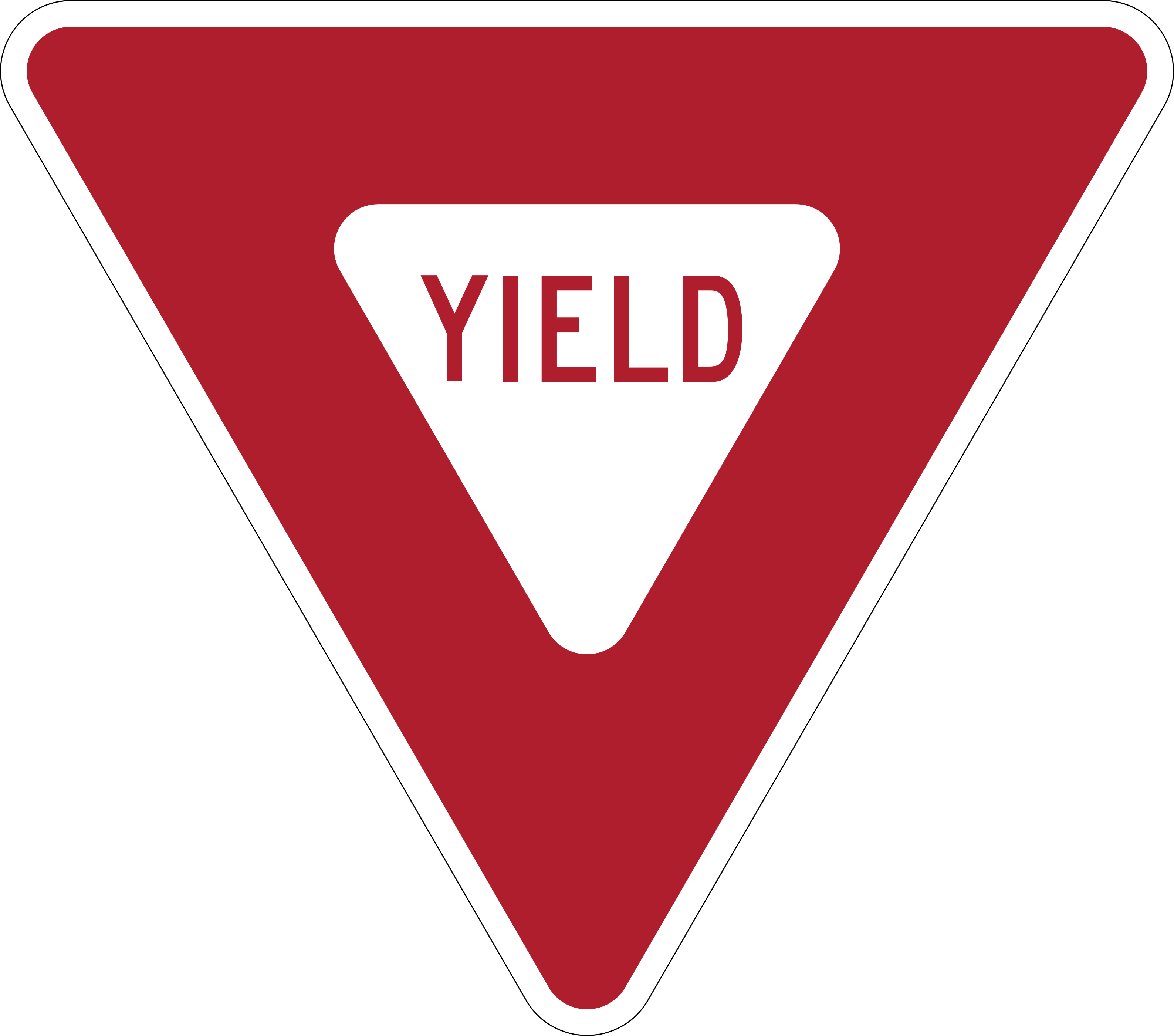
10. What does this yield sign require of a driver approaching it?
- Slow down, give the right-of-way to cross traffic and pedestrians, and stop if needed. (correct)
- Stop completely at the line every time before entering the intersection.
- Speed up through the intersection to clear it before cross traffic arrives.
- Continue at the posted speed unless a signal or officer directs otherwise.
Why: A yield sign asks a driver to slow, scan for cross traffic and pedestrians, and stop only when someone else has the right-of-way; if the way is clear, the driver may roll through without stopping. The trap is the answer that turns the triangle into a stop sign because both signs are red, but the octagon demands a halt every time and the downward triangle demands one only when a conflict is present.
Source: Manual on Uniform Traffic Control Devices, sign R1-2 (Yield).
-
11. You were in a crash causing about $1,200 in vehicle damage that police did not investigate. How many days do you have to file the Report of Crash Form (SR-1) with the Nevada DMV?
- 15 days.
- 10 days. (correct)
- 30 days.
- 5 days.
Why: Nevada requires a Report of Crash Form (SR-1) when police do not investigate a crash that caused injury or $750 or more in damage. The manual sets a 10-day filing window. If you do not report a required crash to the DMV, your driver license and/or vehicle registration may be suspended.
Source: Nevada Driver Manual, "Chapter 8 - Insurance and Financial Responsibility," p.75.
-
12. A solid white line runs along the right side of the roadway. What does it mark?
- The right edge of the travel lane and the boundary with the shoulder (correct)
- The centerline between traffic moving in opposite directions
- The boundary between two travel lanes going the same direction
- A zone where passing other vehicles is prohibited
Why: A solid white line on the right side of the road marks the right edge of the travel lane and separates the lane from the shoulder. The trap is the same-direction lane choice: white does divide lanes moving the same way, and a driver applying that broad rule can miss that this particular line hugs the shoulder rather than sitting between two travel lanes.
Source: Manual on Uniform Traffic Control Devices, marking 3B.06 (Solid White Right Edge Line).
-
13. When a Nevada applicant is under 18, who must co-sign the driver's license application?
- A licensed instructor from a DMV-approved school
- Any adult over 18 with a valid Nevada driver's license
- Both parents, even if only one has legal custody
- A custodial parent, legal guardian, or other authorized person (correct)
Why: The manual specifies that a parent with custody, a legal guardian, or another person authorized by NRS 483.300 must co-sign the application of a driver under 18. The co-signer then shares liability for the minor's driving.
Source: Nevada Driver Manual, "Chapter 1 - Getting Your Nevada Driver's License," p.6.
-
14. You move a barrier so you can cross onto a road closed for construction. According to the Nevada manual, what happens?
- It is legal as long as you drive under 15 mph
- It is a warning offense the first time only
- It is legal if no workers or equipment are present
- It is illegal, and you face double work-zone penalties (correct)
Why: The manual bans moving barriers or signs to cross a closed road and pairs the ban with the double-penalty structure that applies to work-zone violations. The wrong answers invent lenient conditions the manual does not provide.
Source: Nevada Driver Manual, "Highway Work Zones," p.60.
-
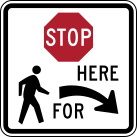
15. What does this Stop Here For Pedestrians sign require of a driver?
- Come to a complete stop for pedestrians at the marked crosswalk on the right. (correct)
- Yield to pedestrians and continue through the crosswalk if it is clear.
- Stop at the sign on every approach, whether or not a pedestrian is present.
- Slow down and watch for people who may cross the road ahead.
Why: The sign is a regulatory instruction to come to a full stop at the stop line for any pedestrian using the marked crosswalk on the right. The trap is the answer that treats it as an unconditional stop on every approach, which borrows the rule from the red octagonal stop sign; this device is triggered by a person in the crosswalk, not by arriving at the sign.
Source: Manual on Uniform Traffic Control Devices, sign R1-5bR (Stop Here For Pedestrians (Right)).
-
16. What does this advance warning sign tell a driver about the road ahead?
- Railroad tracks cross ahead; slow down and be ready to stop for a train. (correct)
- Railroad tracks are at this location; yield to any approaching train.
- A traffic light is ahead where the driver may need to stop.
- A school crossing is ahead with children who may be crossing.
Why: The round yellow disc is the advance warning that railroad tracks cross the road ahead, so you slow down, look both ways, and be ready to stop for a train. The trap is the choice that treats this sign as the crossbuck posted at the tracks themselves; the crossbuck is white and X-shaped, while this round yellow sign sits back from the crossing to warn a driver in time to slow.
Source: Manual on Uniform Traffic Control Devices, sign W10-1 (Highway-Rail Grade Crossing (Round Advance Warning)).
-
17. At freeway speeds, the manual says you need to look ahead at least how many seconds?
- 20 to 30 seconds (correct)
- 2 to 4 seconds
- 5 to 10 seconds
- 12 to 15 seconds
Why: At highway speed, situations develop faster and require a longer forward scan. The tips call for 20 to 30 seconds of look-ahead at freeway speeds so drivers spot hazards early enough to plan lane changes and slow down smoothly.
Source: Nevada Driver Manual, "Defensive Driving Tips," p.42.
-
18. What is the primary purpose of construction and maintenance signs on Nevada roads?
- To provide detour directions to alternate routes
- To notify drivers of possible danger in or near work areas (correct)
- To advertise upcoming road projects funded by the state
- To restrict certain vehicle types from entering a work zone
Why: The manual states construction and maintenance signs exist to notify drivers of possible danger in or near work areas. Their purpose is safety warning, not advertising, restriction, or detour direction. The wrong choices reflect common mislabelings of the sign category.
Source: Nevada Driver Manual, "Construction and Maintenance Signs," p.30.
-
19. Two broken yellow lines border a center lane with overhead lane-control signals. What authorizes a driver to enter that lane?
- A green arrow on the overhead lane-control signal above that lane. (correct)
- A clear gap in oncoming traffic long enough to pass safely.
- A left turn or U-turn the driver is preparing to make.
- A posted speed limit that allows use of a center lane.
Why: Two broken yellow lines mark a reversible lane whose direction of travel changes by time of day or traffic demand. Enter only when the overhead lane-control signal above the lane shows a green arrow for your direction, never under a red X. Drivers who first learned broken yellow as the passing-allowed line on an ordinary two-way road judge a gap in oncoming traffic instead of looking up at the signal above the lane.
Source: Manual on Uniform Traffic Control Devices, marking 3B.04 (Double Broken Yellow Line (Reversible Lane)).
-
20. A bicycle symbol topped by two white chevron arrows is painted in the middle of a travel lane. What does this marking tell a driver?
- Bicyclists share the lane with cars; expect bikes and pass with care. (correct)
- The lane is reserved for bicycles and closed to motor vehicles.
- Bicyclists must ride to the far right edge of the lane at all times.
- A bike route crosses the road ahead, so watch for cyclists from the side.
Why: A sharrow tells drivers that bicyclists share the same travel lane. Pass only when you can give the rider a safe buffer, and change lanes if the lane is too narrow to share side by side. A bike lane is a separate bicycle space marked by lane lines; a sharrow sits in a general travel lane that bikes and cars share. The bike-only reading is the trap for drivers who spot the painted bike symbol and skip past the chevrons on top that mark the lane as shared.
Source: Manual on Uniform Traffic Control Devices, marking 3C.04 (Shared-Lane Marking (Sharrow)).
-
21. In Nevada, which color identifies the signs that warn drivers of a highway work zone?
- Orange (correct)
- Red
- Yellow
- White
Why: The Nevada manual states that work zones are identified with orange signs, matching the standard color code that assigns orange to road construction or repair warnings. The wrong answers substitute other Nevada sign colors that carry different meanings (general warning, regulatory, and stop or prohibition).
Source: Nevada Driver Manual, "Highway Work Zones," p.60.
-
22. You are braking on packed snow in a vehicle equipped with ABS. How does the Nevada manual say to press the brake pedal?
- Tap lightly at first, then push hard once you feel traction.
- Apply firm, continuous pressure to activate the anti-lock feature. (correct)
- Push the pedal down until it stops, then release and repeat.
- Pump the pedal in short, quick bursts to prevent skidding.
Why: The Driving in Bad Weather section describes gentle touch-and-release braking as the default on snow and ice, then flips the rule for ABS-equipped vehicles: firm continuous pressure is what activates the anti-lock feature. Drivers taught the pumping habit often carry it into ABS vehicles and defeat the system.
Source: Nevada Driver Manual, "Chapter 5, Driving in Bad Weather," p.57.
-
23. Two parallel solid white lines separate lanes traveling in the same direction. What do they require of a driver in one of those lanes?
- Remain in your current lane and do not cross the marking. (correct)
- Change lanes only when a driver behind you signals to pass.
- Yield to the adjacent lane, then merge across when it is clear.
- Cross only to enter or exit a carpool lane on the left.
Why: Two solid white lines forbid lane changes, so you stay in your current lane until the marking becomes a broken or single line. The trap is the carpool-lane answer: this pattern often runs along the edge of an HOV or managed lane, and a driver eligible for that lane assumes eligibility lets them slip across the paint. The line itself is the barrier, and entry to the HOV lane happens only where the marking changes.
Source: Manual on Uniform Traffic Control Devices, marking 3B.04 (Double Solid White Lane Line).
-
24. What should a driver do when approaching this Divided Highway Ends sign?
- Keep right and be ready for oncoming traffic in the lane next to you. (correct)
- Merge left because the right lane ends ahead.
- Yield to traffic entering from a road that joins on the right.
- Prepare to stop because two one-way roadways are ending at an intersection.
Why: The two separated one-way roadways are about to merge back into one two-way road, so keep right and be ready for opposing traffic in the lane next to you. Passing here is risky because the neighboring lane now carries vehicles coming toward you rather than traveling with you. Drivers who read the word 'ends' on a yellow diamond as a lane drop reach for the merge-left answer, treating this the way they would a lane-reduction warning that uses the same shape and color.
Source: Manual on Uniform Traffic Control Devices, sign W6-2 (Divided Highway Ends).
-
25. What should you do when this Hill sign warns of a downgrade ahead?
- Reduce speed and shift to a lower gear before starting down. (correct)
- Stop completely at the crest before beginning the descent.
- Yield to any vehicles climbing the grade from below.
- Hold your speed and rely on the brakes throughout the descent.
Why: The Hill sign warns that a steep downgrade is ahead, and the safe response is to slow down and shift to a lower gear before you start down so engine braking helps control your speed. The answer that says to hold your speed and rely on the brakes is the trap: it borrows the everyday habit of tapping the brakes on a mild slope, which lets the brakes overheat and fade on a real grade.
Source: Manual on Uniform Traffic Control Devices, sign W7-1 (Hill).
Keep going.
Want explanations one question at a time? Browse every Nevada practice question or jump into the topic study guide.