California Practice Test
A full-length practice test for the California DMV knowledge test.
25 Questions Click an answer to reveal the explanation






California Practice Test (25 questions). Correct answers and explanations are noted under each question.
-
1. A curb painted white allows you to do what?
- Stop only long enough to pick up or drop off passengers. (correct)
- Park for a limited time posted on nearby signs.
- Load and unload freight while staying with the vehicle.
Why: White curbs are for short stops to pick up or drop off passengers, nothing else. A driver who picks the time-limited parking option has confused white with green, the color listed immediately below it in the same section.
Source: California Driver Manual, "Parking at Colored Curbs," p.28.
-
2. A lane is marked with this straight-or-right combination arrow. What does it permit a driver in that lane to do?
- Continue straight through the intersection or turn right. (correct)
- The lane is a right-turn-only lane; you must turn right.
- You must go straight; turning right from this lane is not allowed.
Why: The combination arrow marks an optional-movement lane: a driver may either continue straight through the intersection or turn right from the same lane. The tempting wrong pick is the right-turn-only reading, which comes from treating the second arrowhead as if it were a standalone right-turn arrow and ignoring the straight shaft paired with it.
Source: Manual on Uniform Traffic Control Devices, marking 3B.23 (Straight-or-Right Combination Arrow).
-
3. How long must a minor hold an instruction permit before scheduling the behind-the-wheel drive test?
- 3 months
- 12 months
- 6 months (correct)
Why: The manual requires a minor to hold the instruction permit for at least 6 months, or turn 18, before the drive test. The 12-month answer matches the length of the post-license provisional restrictions that begin after licensure, and readers confuse the two windows because they sit on adjacent pages.
Source: California Driver Manual, "Applying For A Driver's License," p.3.
-
4. What does the traffic term 'yield' require a driver to do?
- Come to a full stop before entering the intersection.
- Slow down and be ready to stop for others with right-of-way. (correct)
- Continue at the same speed unless another vehicle blocks you.
Why: The manual defines yielding as slowing down and being ready to stop so someone with right-of-way can proceed. Choice A is the trap for learners who treat every yield sign as if it were a stop sign, applying the stricter rule from a familiar red-octagon habit.
Source: California Driver Manual, Glossary, "Yield," p.83.
-
5. A broken white line separates your lane from the lane to your left, both traveling in the same direction. What does this marking permit?
- Lane changes across the line when it is safe to do so. (correct)
- Passing by crossing into oncoming traffic.
- Crossing only in an emergency.
Why: A broken white line divides lanes moving the same way, and a driver may cross it to change lanes whenever the move is safe: signal, check mirrors and blind spots, then move over. The choice about passing into oncoming traffic reaches for the rule that governs broken yellow center lines on two-way roadways; broken white never sits between opposing lanes and has nothing to do with oncoming vehicles.
Source: Manual on Uniform Traffic Control Devices, marking 3B.04 (Broken White Lane Line).
-
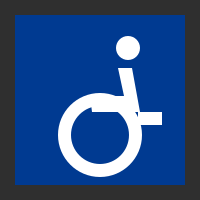
6. The blue wheelchair symbol painted on a parking space marks the space as what?
- Reserved for vehicles displaying a valid disability placard or plate. (correct)
- Free parking closest to the entrance for any driver in a hurry.
- Loading zone for wheelchair-accessible vans during business hours.
Why: A parking space marked with the wheelchair symbol is reserved for vehicles displaying a valid disability placard or license plate. The trap is the answer that treats the symbol as a convenience marker for the closest spot to the entrance; these spaces are often near the door, but proximity is not what the paint reserves. Access for a placard or plate holder is.
Source: Manual on Uniform Traffic Control Devices, marking 3B.27 (Accessible Parking Symbol).
-
7. Vehicle trouble forces you off the road. Where does the manual specifically warn you not to stop?
- Do not stop just over a hill or just around a curve (correct)
- Do not stop on a shoulder unless a call box is nearby
- Do not stop on a paved surface if soft ground is available
Why: Do not stop just over a hill or just around a curve, because following drivers may not see your vehicle in time to avoid a collision. Choice B swaps that visibility-from-behind test for a call-box condition, a trap for drivers who lean on California's freeway call-box network and treat reaching help as part of the stopping rule.
Source: California Driver Manual, "Using Your Emergency Flashers," p.12.
-
8. How far ahead should you scan the road as you drive?
- As far as your headlights reach at night
- At least 10 seconds ahead of your vehicle (correct)
- To the next visible intersection or turn
Why: The California manual sets 10 seconds as the minimum scanning distance so you have time to spot hazards ahead. Choice A tempts drivers who equate safe scanning with what their headlights actually light up at night; at highway speed the beams fall well short of 10 seconds, and the manual pins the rule to a time count, not a lit distance.
Source: California Driver Manual, "Be Aware of Your Surroundings," p.57.
-
9. After stopping at a collision scene where someone is hurt, what should you do right away?
- Call 911 right away for medical help (correct)
- Exchange insurance information with the other driver
- Move both vehicles off the road
Why: The manual is explicit: call 911 right away when anyone is hurt, before you exchange information or move any vehicle. Showing your license, registration, and insurance comes later in the same list, once help is on the way. Choice B is the very next step in that list, and a driver who learned the no-injury routine first applies it here and skips the injury check the manual puts ahead of it.
Source: California Driver Manual, "What to Do if You Are in a Collision," p.77.
-
10. You are in a collision without insurance, but the other driver caused it. Under California's no-insurance rule, what happens to your driving privilege?
- Nothing, because the other driver was at fault.
- It will be suspended for up to four years regardless of fault. (correct)
- It is suspended only if you also receive a traffic ticket.
Why: California suspends the driving privilege for up to four years when a driver is in a collision without proper insurance, and it does not matter who caused the crash. Option A carries over the fairness logic that decides who pays for damages, where being blameless matters, and applies it to a suspension rule that only asks whether coverage was in place.
Source: California Driver Manual, "Driving Without Insurance," p.76.
-
11. You are arrested for DUI. The officer takes your driver's license at the scene. What are you given in exchange?
- A permanent replacement license until court.
- A court date and no driving privileges until resolution.
- A temporary driver's license valid for 30 days. (correct)
Why: When you are arrested for DUI, the officer may take your license and give you a temporary one valid for 30 days, subject to DMV's Administrative Per Se suspension and the 10-day hearing request window. Choice B follows the assumption that an arrest immediately ends driving privileges, missing the 30-day temporary card California writes into the arrest process.
Source: California Driver Manual, "DUI Arrests," p.74.
-
12. A wide solid white line separates a freeway through lane from an exit ramp at the gore. What does it require of you?
- Settle into your lane before the line; crossing it is discouraged. (correct)
- Cross freely between the through lane and the ramp.
- Crossing is prohibited and can be ticketed.
Why: The wide solid white line at a ramp gore forms a neutral area between two paths of same-direction traffic. Settle into either the through lane or the ramp before you reach it, and stay out of the painted zone. The tempting wrong answer is the one that treats the solid white as a broken white lane line. A broken white line invites lane changes; a solid white channelizing line is drawn to hold you in the path you have already chosen, so drivers who are still deciding should decide sooner.
Source: Manual on Uniform Traffic Control Devices, marking 3B.08 (White Channelizing Line).
-
13. To help manage sun glare, what does the manual say to avoid?
- Driving at midnight and midday.
- Driving during sunrise and sunset. (correct)
- Driving during peak rush hour periods.
Why: The sun-glare section names sunrise and sunset as the times to avoid driving. A applies a general 'avoid the busy hours' instinct to a paragraph whose cue is actually the sun's angle, not how heavy traffic is.
Source: California Driver Manual, "Sun Glare," p.60.
-
14. According to the manual, when can pavement be at its most slippery?
- After several hours of rainfall.
- When it starts to rain. (correct)
- When temperatures rise above 80 degrees.
Why: The slippery-roads section warns that pavement is at its slickest when rain first starts, because oil and dust have not been washed off yet. The 'after several hours' choice assumes more water means more slip, which reverses the actual rule.
Source: California Driver Manual, "Slippery Roads," p.61.
-
15. A law enforcement officer directs you to do something that conflicts with the posted traffic signs. What does the manual tell you to do?
- Follow the officer's orders (correct)
- Follow the posted signs
- Stop and wait for a second officer
Why: The manual says to follow the officer's orders even when they conflict with existing signs, signals, or laws. Choice B reflects the deeper 'always obey signs' training a driver has practiced for years; the manual carves out this one exception because the officer is responding to a live hazard the sign does not know about.
Source: California Driver Manual, "Emergency Vehicles," p.45.
-
16. An officer is conducting a law enforcement traffic break ahead of you. What does the manual say to do about your speed?
- Stop completely on the right shoulder.
- Speed up to pass the patrol vehicle.
- Slow to the same speed as the officer. (correct)
Why: During a traffic break, slow to match the officer's pace and stay behind the patrol vehicle. A carries over the pull-onto-the-shoulder response drilled in for a passing emergency vehicle, a different scenario where that rule does apply.
Source: California Driver Manual, "Law Enforcement Traffic Breaks," p.64.
-
17. What does this yellow-green pentagon sign tell you about the road ahead?
- A school zone or school crossing is ahead; slow down and watch for children. (correct)
- A pedestrian crosswalk is ahead; yield to any pedestrian already in the road.
- A stopped school bus with flashing lights is ahead; prepare to stop until the lights go off.
Why: The pentagon shape and fluorescent yellow-green color mark the school advance warning: a school zone or a school crossing is ahead, so slow down and watch for children stepping into the road. The trap is the plain pedestrian-crosswalk reading. Fluorescent yellow-green is also used on general pedestrian warnings, so a driver who keys on color alone and skips over the pentagon outline reaches for the crosswalk answer, when the five-sided shape is reserved for schools.
Source: Manual on Uniform Traffic Control Devices, sign S1-1 (School Advance Warning).
-
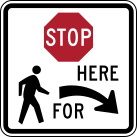
18. What does this Stop Here For Pedestrians sign require of a driver?
- Come to a complete stop for pedestrians at the marked crosswalk on the right. (correct)
- Yield to pedestrians and continue through the crosswalk if it is clear.
- Stop at the sign on every approach, whether or not a pedestrian is present.
Why: The sign is a regulatory instruction to come to a full stop at the stop line for any pedestrian using the marked crosswalk on the right. The trap is the answer that treats it as an unconditional stop on every approach, which borrows the rule from the red octagonal stop sign; this device is triggered by a person in the crosswalk, not by arriving at the sign.
Source: Manual on Uniform Traffic Control Devices, sign R1-5bR (Stop Here For Pedestrians (Right)).
-
19. What does this Lodging sign tell a driver?
- A hotel, motel, or other overnight lodging is available ahead. (correct)
- A public rest area with restrooms is available ahead.
- A campground for overnight camping is available ahead.
Why: The blue Lodging services sign marks a hotel, motel, or other overnight lodging near the exit ahead. The choice pointing to a rest area is the trap because both signs are blue services panels, and a driver who does not check the pictograph reaches for the roadside stop a highway traveler uses more often. The person-lying-in-a-bed pictograph separates them: it signals a paid room for the night, not a roadside pull-out.
Source: Manual on Uniform Traffic Control Devices, sign D9-9 (Lodging).
-
20. Your license is suspended for driving uninsured in a collision. When can you begin to get it back?
- Immediately, once you buy a policy.
- Only after paying the property-damage judgment in full.
- During the last three years of the suspension, with an SR 22/SR 1P. (correct)
Why: You can begin getting your license back during the last three years of the four-year suspension by filing an SR 22/SR 1P and keeping it in force. A driver drawn to A reads buying a policy after the fact as fixing the underlying problem, missing that the suspension runs on its own clock regardless of new coverage.
Source: California Driver Manual, "Driving Without Insurance," p.76.
-
21. About how far in advance of your California driver's license expiration date does DMV send a renewal notice to your address of record?
- Only on the day the license expires.
- About 90 days before expiration. (correct)
- 30 days ahead of the expiration date.
Why: The manual says DMV mails a renewal notice to the address of record about 90 days before the driver's license expires. Choice C is the 30-day figure drivers pull from utility bills and other short-cycle reminders; DMV starts the renewal window well before that.
Source: California Driver Manual, "Driver's License Renewal (Seniors and Driving)," p.82.
-
22. Under California's standard provisional-license passenger restriction, passengers under what age require a parent, guardian, or California-licensed driver at least 25 years old in the vehicle?
- 18
- 20 (correct)
- 21
Why: Under the standard provisional-license passenger restriction, you can't carry anyone under 20 unless a parent, guardian, or California-licensed driver at least 25 rides with you. The manual lists separate exceptions for medical, school, work, and immediate-family trips, each requiring a signed note. Picking C carries over the alcohol-purchase age of 21 as the default cutoff for any young-people rule, when the manual sets its passenger cap lower.
Source: California Driver Manual, "Minor's Restrictions and Exceptions," p.4.
-
23. What does this sign require of a driver in the right lane?
- Merge left into the adjacent through lane because the right lane is ending ahead. (correct)
- The left lane is closing, so shift one lane to the right.
- Stay in the right lane, which becomes an exit-only lane at the ramp ahead.
Why: This yellow diamond warns that the right lane is closing, so a driver in it must signal, find a gap, and merge into the adjacent through lane on the left before the pavement drops. The trap is the answer that flips the merge direction; a driver who mixes this sign up with Left Lane Ends reads the tapered side as the left lane and moves right into a lane that has no reason to yield to them.
Source: Manual on Uniform Traffic Control Devices, sign W4-2R (Lane Ends (Right Lane Ends)).
-
24. Unless otherwise posted, what is the speed limit in a business or residential district?
- 35 mph
- 45 mph
- 25 mph (correct)
Why: The manual sets 25 mph as the default limit in a business or residential district unless a sign posts something different. The 35 mph in A is the figure often posted on a busy through street, and a driver who anchors on the sign seen daily on the commute reads it as the neighborhood default.
Source: California Driver Manual, "Business or Residential Districts," p.51.
-
25. You approach a signal that is showing a yellow arrow for your turn. What does the yellow arrow mean?
- Oncoming vehicles have just received a green light and will proceed.
- The protected turning time is ending and the signal will change soon. (correct)
- Turns from that lane are prohibited until further notice.
Why: A yellow arrow means the protected turning time is ending and the signal will change soon; if you cannot stop safely or are already in the intersection, cautiously complete the turn. Reading the arrow as a prohibition sign, as C does, is the habit of a driver who defaults to treating unfamiliar traffic symbols as bans.
Source: California Driver Manual, "Traffic Signals: Yellow Arrow," p.33.
Keep going.
Want explanations one question at a time? Browse every California practice question or jump into the topic study guide. Ready to close the gaps for good? Own the California book and its study system.